

Imagine this. It’s 3 PM on a Tuesday. You’ve been staring at your screen since 9 AM, back-to-back meetings, code reviews, Excel sheets, Zoom calls. Somewhere around lunchtime, a dull ache crept into the back of your neck. You ignored it. Now your shoulder feels like it’s carrying a bag of bricks.
Sound familiar? If you work a desk job or in IT, chances are it does. Neck and shoulder muscle pain in office workers has become one of the most common complaints I see as an orthopaedic surgeon in Indore and it’s only growing.
The good news? Most of this pain is preventable and treatable. Let’s break it down in plain language.
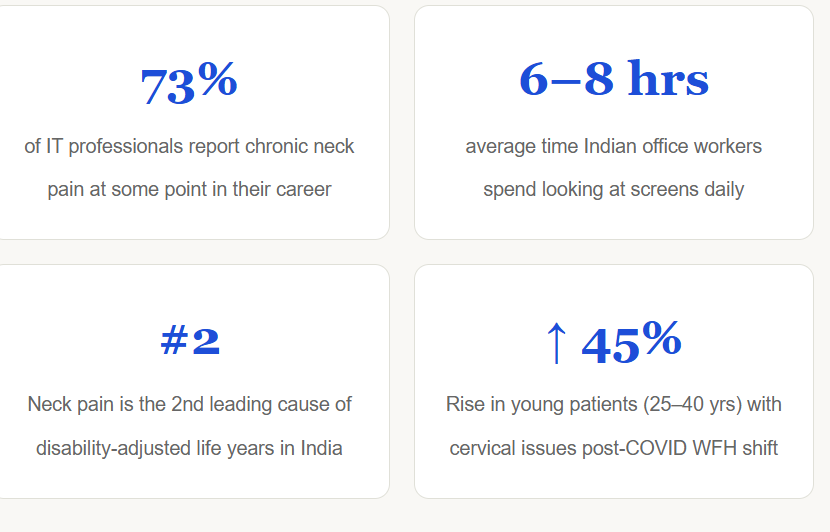

Why Does Your Desk Job Hurt Your Neck and Shoulders?
Your head weighs about 4–5 kg. When you sit upright, your spine handles that load easily. But for every inch you push your head forward like when you’re squinting at a laptop, the effective load on your neck nearly doubles. At a 45-degree forward tilt, your neck muscles are managing the equivalent of 22 kg. All day. Every day.
This is called forward head posture, and it’s the single biggest driver of posture-related neck pain in office workers.
Main Causes of Neck and Shoulder Pain in IT Workers
- Forward head posture — leaning toward your screen, chin jutting forward
- Screen height mismatch — laptop screens too low, forcing the head down for hours
- Mouse and keyboard position — reaching forward or sideways strains shoulder muscles
- No movement breaks — sitting still for 2–3 hours locks the muscles in a shortened state
- Work-from-home setups — beds, sofas, dining tables are not ergonomic workstations
- Phone use after work — “text neck” from looking down at your phone adds to the load
- Stress and tension — mental stress causes people to unconsciously raise their shoulders

Symptoms: What Does Muscle Pain Actually Feel Like?
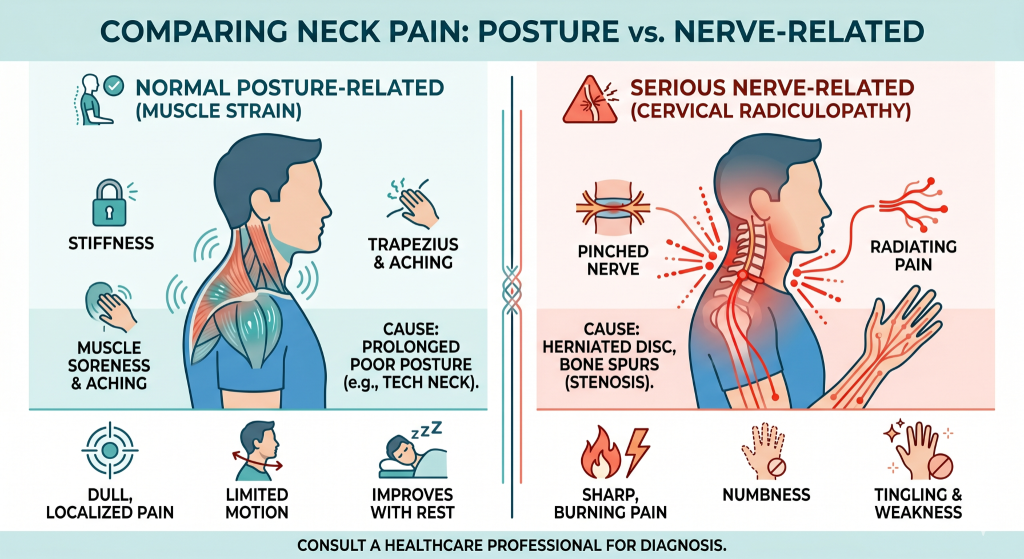
Not all neck and shoulder pain is the same. Here’s what typical muscle-related neck pain in office workers feels like:
- Dull, aching stiffness in the neck or upper back, worse by the end of the day
- Tightness or “knots” in the shoulders or trapezius muscles
- Headaches starting from the base of the skull
- Difficulty turning your head fully to one side
- Mild soreness that improves with movement or after sleep
Normal Muscle Pain vs. Something More Serious — Know the Difference
This is where many patients get confused and where it matters most. Not all neck pain is just “stress.” As an orthopedic surgeon in Indore, I want you to know these red flags.
| Feature | Muscle / Posture Pain Usually Safe | Serious Condition |
| Location | Neck, upper back, shoulders | Radiates to arms, hands, or fingers |
| Onset | Gradual, builds over hours/days | Sudden, sharp, or after injury |
| Tingling / Numbness | None | Yes, fingers, forearm, or hand go numb |
| Weakness | No arm or hand weakness | Grip strength reduced, dropping things |
| Headache | Tension-type, mild | Severe, sudden (“thunderclap”) headache |
| Relief | Improves with rest, stretching, heat | No relief with rest; worsens at night |
| Duration | Resolves in days to weeks | Persists over 6 weeks or keeps returning |
| Likely Cause | Muscle strain, poor posture | Cervical disc herniation, nerve compression, spondylosis |
Seek immediate care if: You have neck pain with chest pain, weakness in both legs, loss of bladder/bowel control, or following a fall or accident. These are emergencies.
Treatment Options for Neck and Shoulder Pain
The right neck pain treatment depends on how serious your condition is. Here’s how we typically approach it:
1. Conservative (First-Line) Treatment
- Physiotherapy: the most effective long-term solution for posture-related pain
- Hot/cold therapy: heat relaxes tight muscles; cold reduces inflammation after acute injury
- Pain relief medications: anti-inflammatory drugs for short-term relief (consult your doctor)
- Posture correction: ergonomic adjustments at your workstation
- Cervical collar : for short periods during acute flare-ups only
2. Intermediate Interventions
- Trigger point injections — for stubborn muscle knots that don’t respond to therapy
- Nerve block injections — when nerve pain is significant
- Traction therapy — gently decompresses cervical vertebrae
3. Surgery (Rare, Only When Necessary)
Surgery is considered only when there is confirmed nerve compression causing progressive weakness, loss of sensation, or when conservative treatment has failed for 6+ months. Most patients over 90% do not need surgery.
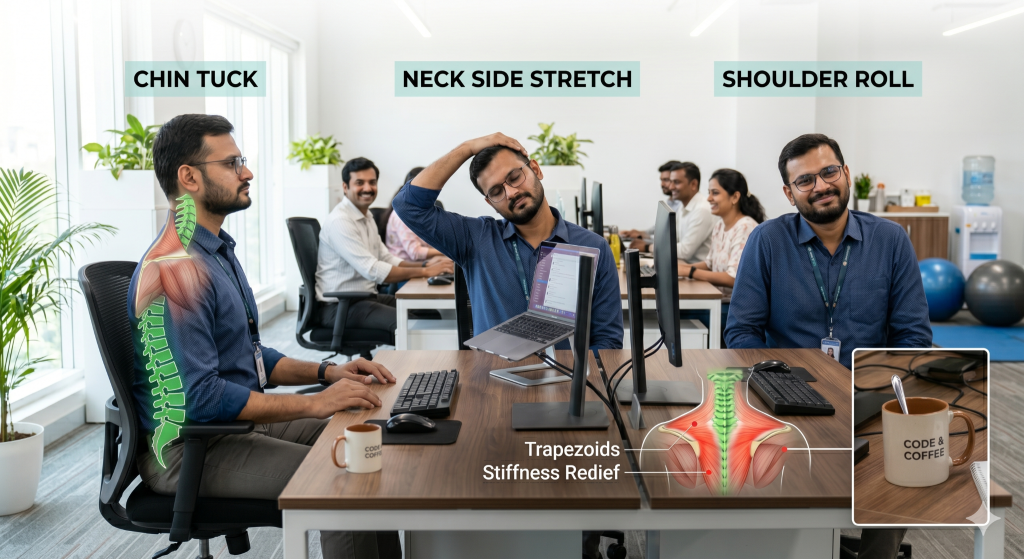
5 Stretches and Exercises You Can Do at Your Desk
These are simple, safe, and effective. They take under 10 minutes and can be done right at your workstation.
1. Chin Tuck Gently pull your chin straight back (like making a double chin). Hold 5 seconds. Repeat 10 times. Corrects forward head posture directly.
2. Neck Side Stretch Tilt your right ear toward your right shoulder. Hold 20 seconds. Switch sides. Releases trapezius and scalene muscles.
3. Shoulder Blade Squeeze Sit tall, pull your shoulder blades together, hold 5 seconds, release. Repeat 15 times. Strengthens weak postural muscles.
4. Doorway Chest Stretch Place both forearms on a door frame, step through. Hold 30 seconds. Opens tight pectoral muscles that pull shoulders forward.
5. Upper Trap Stretch Place one hand behind your back. With the other hand, gently pull your head toward the opposite shoulder. Hold 20–30 seconds each side.
6. The 20-20-20 Rule Every 20 minutes, look 20 feet away for 20 seconds — then stand and roll your shoulders 5 times. Simple but powerful.
Pro tip: Set a phone alarm every 45 minutes as a “posture check.” The moment it rings, sit back, drop your shoulders, and tuck your chin. That’s all it takes to interrupt the damage cycle.
Prevention Tips for IT Professionals
- Raise your laptop or monitor to eye level, your screen top should be at eye height
- Use an external keyboard and mouse when using a laptop for long periods
- Your chair should support your lower back; feet flat on the floor
- Keep your phone at eye level when reading, and avoid “text neck”
- Walk for 5 minutes every hour; movement is the best medicine
- Sleep on a supportive pillow one that keeps your neck in a neutral position
- Strengthen your core weak core = more load on the neck and back
- Stay hydrated intervertebral discs are largely water; dehydration stiffens them

When to See an Orthopedic Doctor for Neck Pain
Most muscle pain resolves with rest and home care within 1–2 weeks. But please book an appointment with an orthopedic surgeon in Indore if you notice any of the following:
- Pain that has lasted more than 3–4 weeks without improvement
- Numbness, tingling, or weakness in your hands or arms
- Pain radiating into your shoulder blade or down your arm
- Headaches that keep returning, especially at the base of the skull
- Pain that wakes you up at night
- History of neck injury (accident, fall, sports)
- You’ve tried exercises and rest but nothing helps

Frequently Asked Questions
Q1. Can neck pain from a desk job become permanent?
If ignored for years, yes chronic posture-related neck pain can lead to cervical spondylosis (degeneration of neck vertebrae). However, with proper treatment and lifestyle changes, most people recover fully without permanent damage.
Q2. Is physiotherapy better than painkillers for neck pain?
Yes, for long-term results. Painkillers manage symptoms temporarily. Physiotherapy addresses the root cause — muscle imbalance and poor posture — and provides lasting relief without side effects.
Q3. What is the best sleeping position for neck pain?
Sleeping on your back or side with a cervical-supportive pillow is ideal. Avoid sleeping on your stomach it forces your neck into a rotated position for hours and significantly worsens neck strain.
Q4. How long does neck pain treatment take to show results?
With physiotherapy and posture correction, most patients with muscle-related neck pain see significant improvement in 4–8 weeks. Disc or nerve-related conditions may take longer and require more specialised management.
Q5. Which is the best orthopedic surgeon in Indore for neck and shoulder pain?
Dr. Tarkit Modi is a senior orthopedic and joint replacement surgeon based in Indore with expertise in cervical spine conditions, shoulder disorders, and posture-related musculoskeletal problems common in IT and desk professionals.
Q6. Does shoulder muscle pain in office workers always need surgery?
Rarely. Over 90% of shoulder muscle pain cases in office workers are successfully managed with physiotherapy, targeted exercises, ergonomic adjustments, and occasional injections. Surgery is a last resort when structural damage is confirmed and conservative care has failed.
Don’t Wait for the Pain to Get Worse
If your neck or shoulder pain has been bothering you for weeks or if you’re experiencing tingling in your hands, it’s time to get a proper evaluation. Dr Tarkit Modi’s clinic in Indore offers expert orthopedic assessment, advanced diagnosis, and personalised treatment plans for IT professionals and desk workers.