
A torn meniscus is one of the most common knee injuries, and it often leaves patients with the same question: is there a way to treat it without going through major surgery? Knee arthroscopy is frequently the answer doctors bring up but it’s worth understanding exactly what that means before assuming it’s a quick fix.
Knee arthroscopy is still a surgical procedure, but it’s performed through small incisions using a camera and specialized instruments, rather than a large open incision. For appropriate meniscus tears, it can repair or trim the damaged tissue with less tissue disruption than traditional open surgery though not every tear needs surgery at all.
What Is a Torn Meniscus?
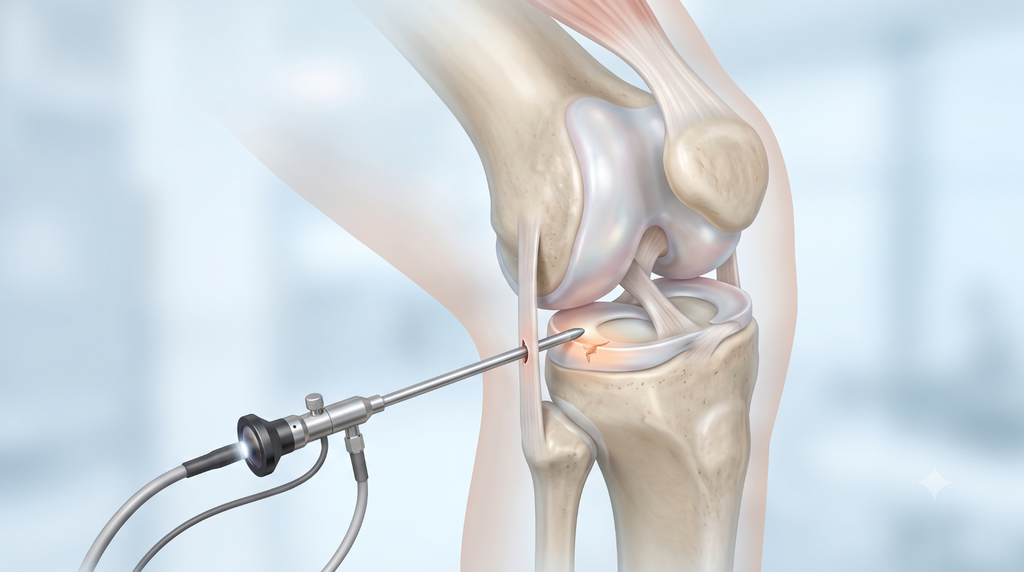
Each knee has two C-shaped pieces of cartilage called the menisci, positioned between the thighbone (femur) and shinbone (tibia). They act as cushions, absorbing shock and helping stabilize the joint during movement. A meniscus tear happens when this cartilage is damaged often from a sudden twisting motion during sports, but also gradually through age-related wear, known as a degenerative tear.
Common symptoms include knee pain, swelling, stiffness, a catching or locking sensation, and difficulty fully straightening the knee. Traumatic tears in younger, active people often behave differently than degenerative tears in older adults, which is part of why treatment isn’t one-size-fits-all.
What Is Knee Arthroscopy?
Knee arthroscopy is a minimally invasive surgical procedure. The surgeon inserts a small camera through a tiny incision to see inside the knee joint, then uses specialized instruments through two or three additional small incisions to treat the problem. Because it avoids the large incision used in traditional open surgery, arthroscopy generally involves less tissue disruption but it’s important to be clear that it is still surgery, performed under anesthesia, with its own recovery process.
Can Knee Arthroscopy Treat a Torn Meniscus?
Knee arthroscopy can be used to treat certain meniscus tears through small incisions. Depending on the tear’s location, pattern, and the condition of the tissue, a surgeon may repair the meniscus or remove only the damaged portion. However, some meniscus tears can improve without surgery at all, so arthroscopy isn’t automatically the answer for every case.
Meniscus Repair
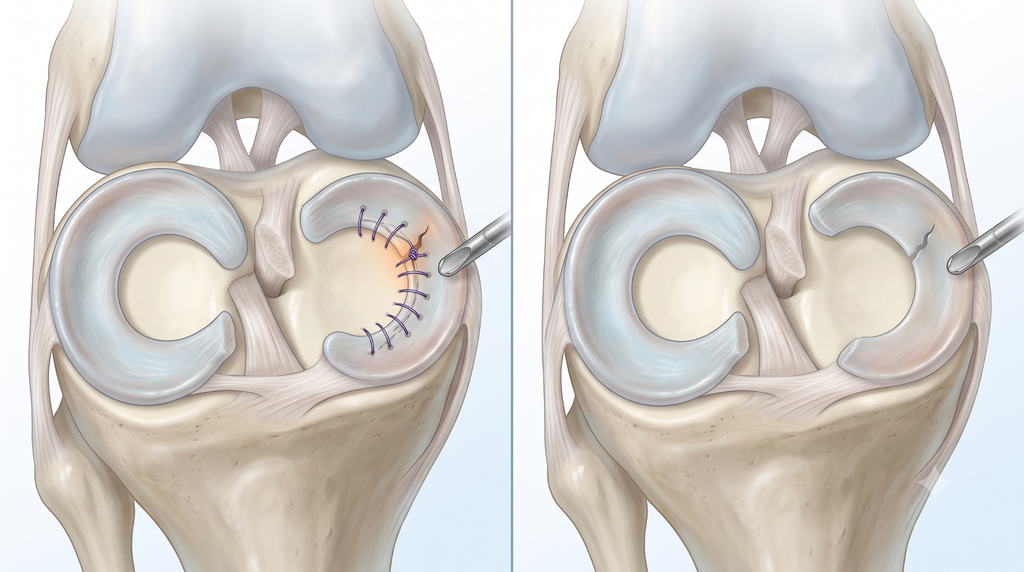
Repair involves stitching the torn edges of the meniscus back together so they can heal. This is generally considered when the tear is in a part of the meniscus with good blood supply, since blood flow is what allows the tissue to actually heal. Repair is often prioritized in younger, active patients, because preserving as much healthy meniscal tissue as possible helps protect the knee’s cartilage and stability long-term. The trade-off is a longer recovery than trimming, since the tissue needs time to heal back together.
Partial Meniscectomy
When a tear can’t be repaired for example, in tissue with poor blood supply, or certain tear patterns like radial tears the surgeon trims away the damaged portion while preserving as much healthy meniscus as possible. This is a shorter procedure with a faster recovery than repair, but it removes tissue rather than restoring it. Neither option is automatically “better” the right choice depends on the specific tear and the patient.
Can a Torn Meniscus Heal Without Surgery?
Yes, in some cases. Smaller tears, tears located in the outer portion of the meniscus (which has better blood supply), and degenerative tears without significant mechanical symptoms may improve with non-surgical care. This typically includes activity modification, physiotherapy and strengthening exercises, and pain management guided by your doctor.
Whether non-surgical treatment is realistic depends heavily on where the tear is, how large it is, and whether it’s causing symptoms like locking or instability that limit daily function. If appropriate conservative treatment doesn’t relieve symptoms, arthroscopic surgery may then be recommended.

When Is Knee Arthroscopy Recommended for a Meniscus Tear?
An orthopedic surgeon may consider arthroscopy when there are persistent symptoms despite conservative treatment, mechanical symptoms such as the knee catching or locking, certain tear patterns unlikely to heal on their own, associated injuries like an ACL tear, or when the tear is significantly limiting daily activity or sport participation. These are considerations weighed together, not fixed rules that apply the same way to every patient.

Knee Arthroscopy vs Traditional Open Knee Surgery
| Feature | Knee Arthroscopy | Traditional Open Surgery |
| Incision | Usually small (a few portals) | Usually larger, single incision |
| Visualization | Camera inside the joint | Direct open access |
| Tissue disruption | Generally less | Generally more |
| Recovery | Often faster, depending on procedure | Depends on the procedure performed |
| Suitability | Depends on the specific tear and condition | Depends on the specific condition |
How Long Does It Take to Recover After Meniscus Arthroscopy?
Recovery depends on which procedure is performed. Rehabilitation after a partial meniscectomy typically takes about 3 to 6 weeks, since no tissue needs time to heal back together. Recovery after a meniscus repair takes longer — generally around 3 to 6 months — because the stitched tissue needs time to heal, along with a structured physiotherapy program to rebuild knee strength and motion. These are general timeframes; your surgeon can give you a more specific estimate based on your procedure and progress.
Is Knee Arthroscopy Safe?
Knee arthroscopy is one of the most commonly performed orthopedic procedures and is generally considered safe. Like any surgery, though, it carries some risk, including infection, blood clots, bleeding, stiffness, persistent symptoms, and — uncommonly — injury to nearby nerves or blood vessels. Your surgeon can walk you through the specific risks relevant to your case before deciding on surgery.
When Should You See an Orthopaedic Doctor for a Torn Meniscus?
See a specialist if you have persistent knee pain, swelling that doesn’t settle, a locking or catching sensation in the knee, difficulty fully bending or straightening the joint, a feeling of instability, difficulty walking, or symptoms that began after a sports injury or twisting movement. An orthopedic evaluation usually including a physical exam and often an MRI is the most reliable way to understand the specific tear and the treatment options that fit it.
Knee arthroscopy is genuinely minimally invasive compared with open surgery, but it’s still a surgical procedure with its own recovery timeline — not a shortcut around surgery altogether. For appropriate meniscus tears, it can repair or trim damaged tissue effectively, but not every tear needs it, and some improve with conservative treatment alone. The right path depends on the tear’s location, pattern, your symptoms, and your activity level. For patients in Indore dealing with a suspected meniscus tear, Dr. Tarkit Modi’s orthopedic clinic can assess the injury and recommend a treatment plan suited to your specific knee.
FAQs
1. Can knee arthroscopy treat a torn meniscus?
Yes, for many meniscus tears, arthroscopy can repair the tear or trim the damaged portion, depending on the tear’s location and condition. However, not every tear requires surgery — some improve with conservative treatment.
2. Is knee arthroscopy considered major surgery?
Knee arthroscopy is a surgical procedure performed under anesthesia, so it is surgery — but it’s minimally invasive, using small incisions rather than a large open cut. Recovery is often shorter than traditional open knee surgery, though it varies by procedure.
3. Can a torn meniscus heal without surgery?
Some tears, particularly smaller ones or those in areas with good blood supply, can improve with activity modification, physiotherapy, and pain management. Whether this is realistic depends on the tear’s size, location, and your symptoms.
4. When does a meniscus tear require surgery?
Surgery may be considered when symptoms persist despite conservative treatment, when there are mechanical symptoms like locking or catching, or when the tear pattern is unlikely to heal on its own. This decision is made case by case with an orthopedic surgeon.
5. Is meniscus repair better than meniscus removal?
Neither is universally better repair preserves more tissue and may benefit long-term knee health but takes longer to heal, while partial meniscectomy has a shorter recovery but removes damaged tissue. The right choice depends on the tear’s location, pattern, and blood supply.
6. How long does it take to recover from meniscus arthroscopy?
Recovery after a partial meniscectomy typically takes about 3 to 6 weeks, while recovery after a meniscus repair generally takes 3 to 6 months due to the healing time needed. Your surgeon can give a more specific timeline based on your procedure.
7. Can you walk after knee arthroscopy?
Many patients can walk with support soon after surgery, though this depends on the specific procedure performed and your surgeon’s guidance. Full weight-bearing and activity are typically resumed gradually as part of a structured rehabilitation plan.
8. What happens if a torn meniscus is left untreated?
Some tears cause minimal ongoing issues, but others can lead to persistent pain, swelling, or a feeling of instability, and may increase the risk of further cartilage damage over time. Anyone with ongoing symptoms should get an orthopedic evaluation rather than assume the tear will resolve on its own.