

Yes. Total hip replacement is a standard treatment for avascular necrosis of the hip once the femoral head has collapsed or the joint has developed arthritis. Before collapse, treatments that try to preserve your own hip are usually considered first. Your scans, symptoms, age and general health decide which route suits you.
What Is Avascular Necrosis of the Hip?
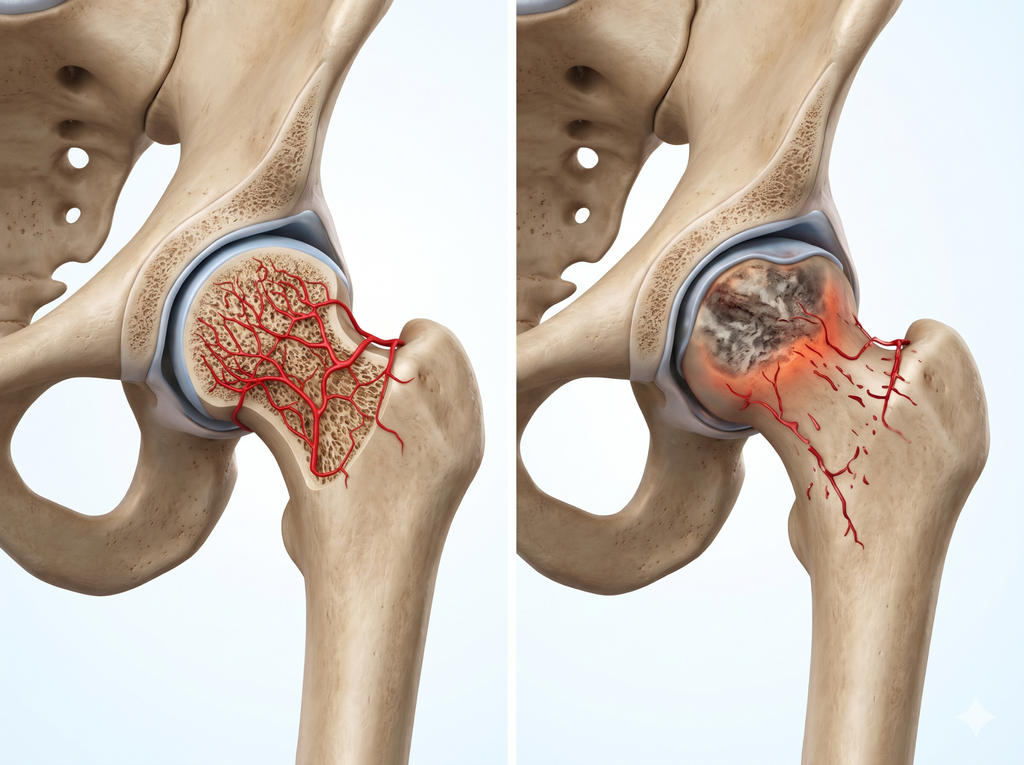
Avascular necrosis (AVN), also called osteonecrosis, develops when the blood supply to the femoral head, the ball of the hip joint, is disrupted. Without enough blood, the bone in that area slowly dies and loses its strength. It can then give way under the load of walking.
Long-term corticosteroid use and heavy alcohol intake are among the best-recognised contributors. Hip injuries, autoimmune conditions, clotting and blood disorders, and smoking are also linked to AVN. Many people have no symptoms at first.
As the condition advances, pain usually appears in the groin, thigh or buttock and can continue at rest. Hip movement often stays fairly good for a while despite significant pain, which is one reason AVN is sometimes picked up late.
What Are the Stages of Avascular Necrosis of the Hip?
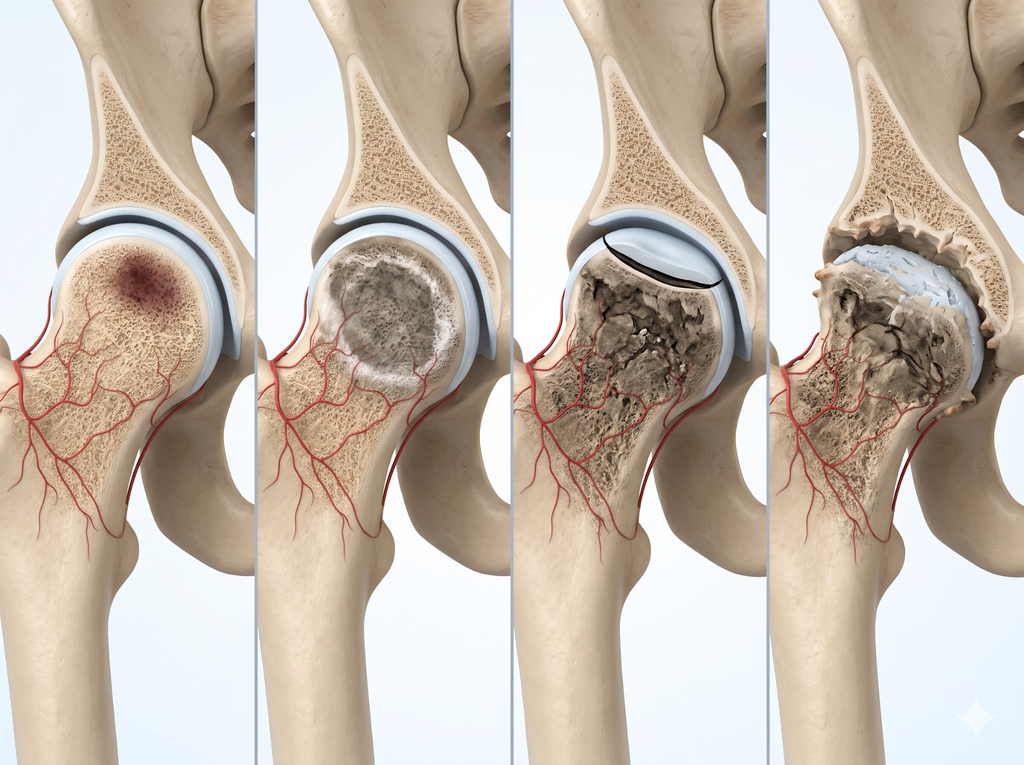
AVN is staged using X-rays, MRI and sometimes CT. The current international guideline, endorsed by the American Academy of Orthopaedic Surgeons in 2026, uses the ARCO staging system. In stages I and II the dead bone is present but the femoral head has kept its shape. Stage III means a fracture has formed beneath the joint surface, with or without collapse. In the most advanced stage, the joint surface is damaged and arthritis develops.
Other staging systems are in use, so two doctors may give different labels to the same hip. The question that matters most is whether the femoral head has collapsed, because that changes the treatment options. MRI detects AVN earlier than a plain X-ray, and CT or MRI shows subchondral fractures better than X-rays do.
When Is Hip Replacement Needed for AVN?
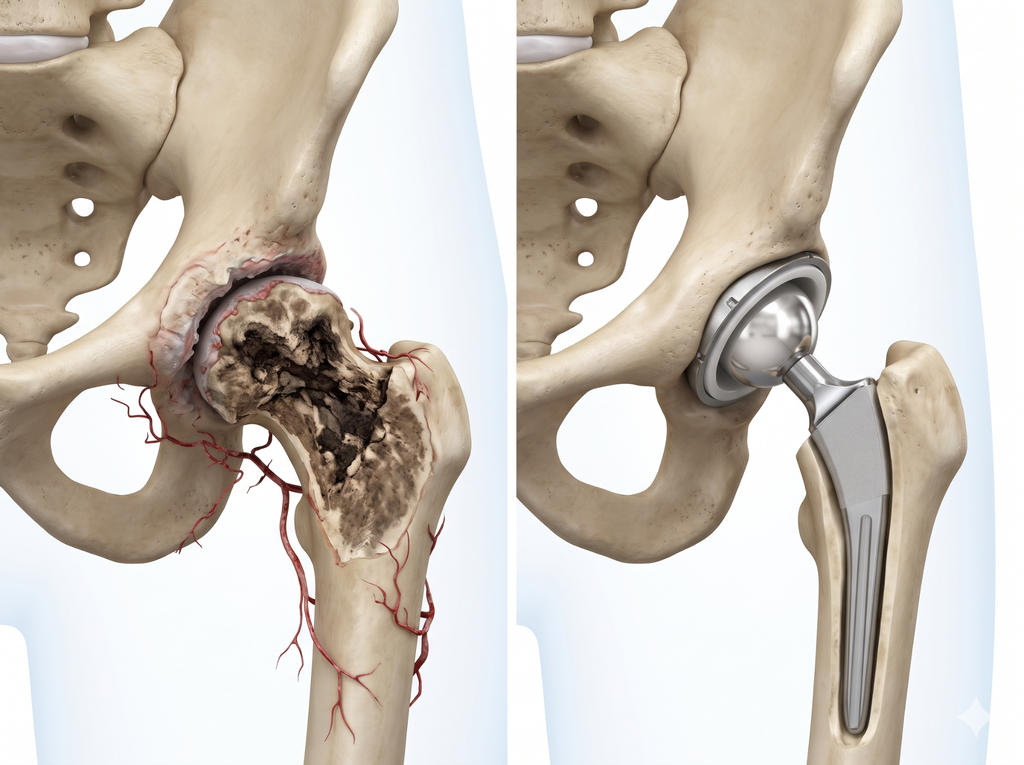
Once the femoral head has collapsed, the American Academy of Orthopaedic Surgeons describes total hip replacement as the most successful treatment. In this operation the damaged ball and socket are replaced with artificial components. That removes the collapsed bone and damaged joint surface that cause the pain.
Stage III, where a fracture is present with or without collapse, is less clear-cut. The 2026 guideline found that head-preserving surgery gives a smaller improvement in function than hip replacement, and the result is less predictable. It still stresses a shared decision between you and your surgeon, particularly if you are young, because keeping your own joint has real value.
Replacement is generally not advised for a painful hip that has not collapsed. The guideline panel recommended considering alternatives first, since the femoral head may still be saved and an early implant increases the chance of further operations over a lifetime. This was a consensus recommendation, as no studies have directly examined the question.
Can AVN Be Treated Without Hip Replacement?
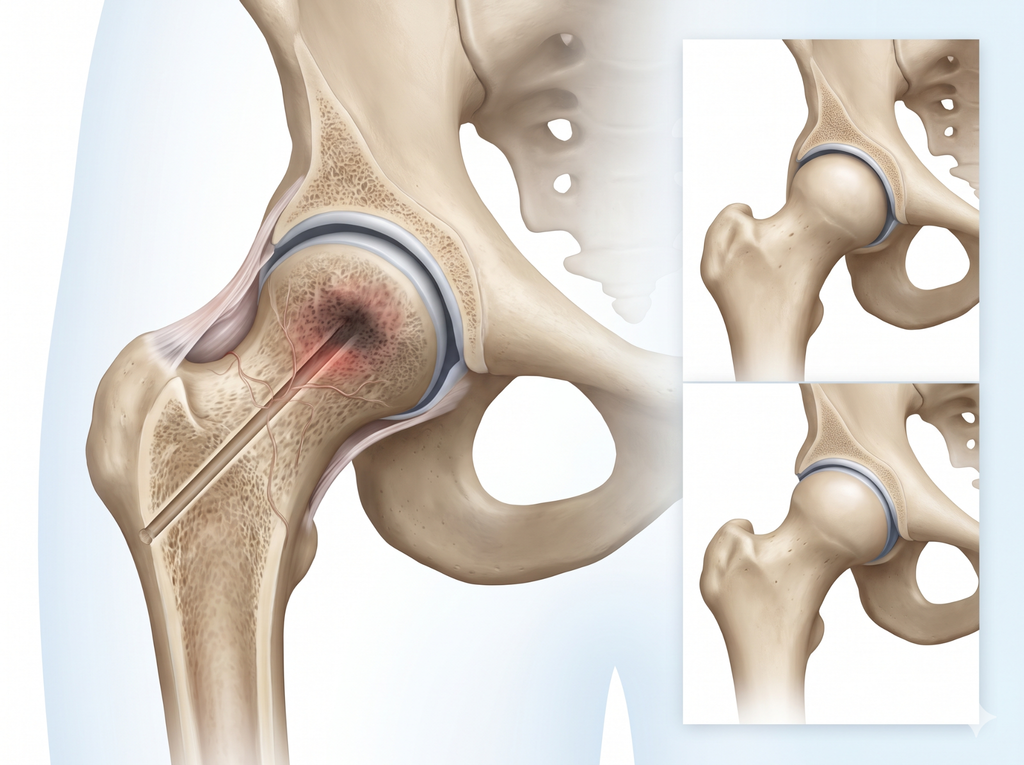
Before collapse, treatment aims to relieve symptoms and delay or prevent collapse. Pain relief and reducing the load on the hip can ease symptoms, though they do not restore dead bone. Surgical options include core decompression, sometimes combined with bone marrow concentrate, and in selected patients an osteotomy or a vascularised fibular graft. The guideline rates the evidence behind these procedures as low or very low quality. Stem-cell injections, platelet-rich plasma, shockwave therapy and similar treatments have too little research for routine recommendation, so it is reasonable to ask what evidence supports any treatment you are offered.
Treatment options for avascular necrosis of the hip (a general guide only; every plan is individual)
| General stage | Condition of the femoral head | Treatments that may be considered | Main objective |
| Early, before collapse | Dead bone present, head still round | Observation in selected painless cases, protected weight-bearing, core decompression, osteotomy or fibular graft in selected patients | Relieve symptoms and try to prevent collapse |
| Fracture or early collapse | Fracture line or early flattening | Head-preserving surgery or total hip replacement, chosen together with your surgeon | Balance joint preservation against dependable pain relief |
| Advanced, with arthritis | Head deformed, joint surface damaged | Total hip replacement | Relieve pain and restore function |
How Well Does Hip Replacement Work for Advanced AVN?
A 2015 review concluded that when collapse or arthritis is present, hip replacement appears to be the most reliable and proven option. Older studies reported poorer results in AVN than in osteoarthritis. A 2011 systematic review of 3,277 hips found that AVN itself was not associated with poor outcomes, although certain underlying risk factors were linked to higher revision rates. Implants and techniques have also improved: an earlier review found far fewer revisions in hips replaced after 1990 than before.
AVN often affects younger adults, who may need a revision operation at some point in their lives. How long an implant lasts depends on age, activity, weight and the implant chosen, so your surgeon can explain what to expect in your own case.
What to Expect After Hip Replacement
Most people stand and begin walking with support soon after surgery and go home within a few days. Walking aids are commonly needed for around four to six weeks. Many people return to light activity and driving at about six to eight weeks, once their surgeon agrees and they can brake safely. Strength and stamina can keep improving for up to a year, and physiotherapy is a central part of that process. Because AVN frequently affects both hips, your surgeon may also keep an eye on the other side.

When Should You Consult an Orthopaedic Specialist?
Hip or groin pain that lasts more than a few weeks deserves assessment. This applies especially if you have taken steroids, drink heavily, have had a hip injury or have had AVN before, even when an X-ray looks normal. An MRI can show early changes before X-rays do, and an early diagnosis keeps more treatment options open. You can book a consultation at my clinic in Indore on +91-8959000069.
Frequently Asked Questions
At what stage of AVN is hip replacement needed?
Hip replacement is usually considered when the femoral head has collapsed or arthritis has set in. Before collapse, current guidelines favour treatments that try to preserve your own hip. Staging needs MRI and sometimes CT, so your surgeon decides after reviewing your scans.
Can AVN be treated without surgery?
Pain relief and reduced weight-bearing can ease symptoms in early disease, but they do not restore dead bone. Before collapse, hip-preserving surgery such as core decompression may be considered. Once the head has collapsed, non-surgical care mainly manages symptoms while surgery is planned.
Is hip replacement effective for advanced AVN?
For advanced AVN, total hip replacement is regarded as the most reliable way to relieve pain and restore function. A 2011 systematic review found AVN itself was not linked to poor outcomes, though some underlying risk factors were linked to higher revision rates. Results and implant life vary between people.
What happens if AVN is left untreated?
AVN often progresses. Loss of blood supply can lead to femoral head collapse and hip arthritis, with worsening pain, stiffness and limping. In studies of painless AVN hips, many went on to develop symptoms or collapse, although small, inner lesions are less likely to progress.
How long does recovery take after hip replacement for AVN?
Most people walk with a frame or crutches soon after surgery and need walking aids for roughly four to six weeks. Light activity and driving often resume at six to eight weeks if the surgeon agrees. Strength and stamina can keep improving for up to a year.
Can AVN return after hip replacement?
AVN affects the femoral head, which is removed during total hip replacement, so the replaced hip cannot develop it again. AVN often affects both hips, though, so the other hip may be at risk and may be monitored. Ask your surgeon whether the other hip needs checking.
Sources
- AAOS/ARCO, Management of Nontraumatic Osteonecrosis of the Femoral Head, clinical practice guideline, ARCO 20 Jan 2026, AAOS-endorsed 4 June 2026: https://www.aaos.org/globalassets/quality-and-practice-resources/external-quality-products/arco/arco-management-of-nontraumatic-osteonecrosis-ot-the-femoral-head.pdf
- AAOS OrthoInfo, Osteonecrosis of the Hip: https://orthoinfo.org/en/diseases–conditions/osteonecrosis-of-the-hip/
- Johannson et al., Int Orthop 2011 (systematic review, 3,277 hips): https://pmc.ncbi.nlm.nih.gov/articles/PMC3066310
- Pierce et al., 2015 review (revision rates before and after 1990): https://pmc.ncbi.nlm.nih.gov/articles/PMC4596201
- Lavernia and Villa, Curr Rev Musculoskelet Med 2015: https://pmc.ncbi.nlm.nih.gov/articles/PMC4596203