
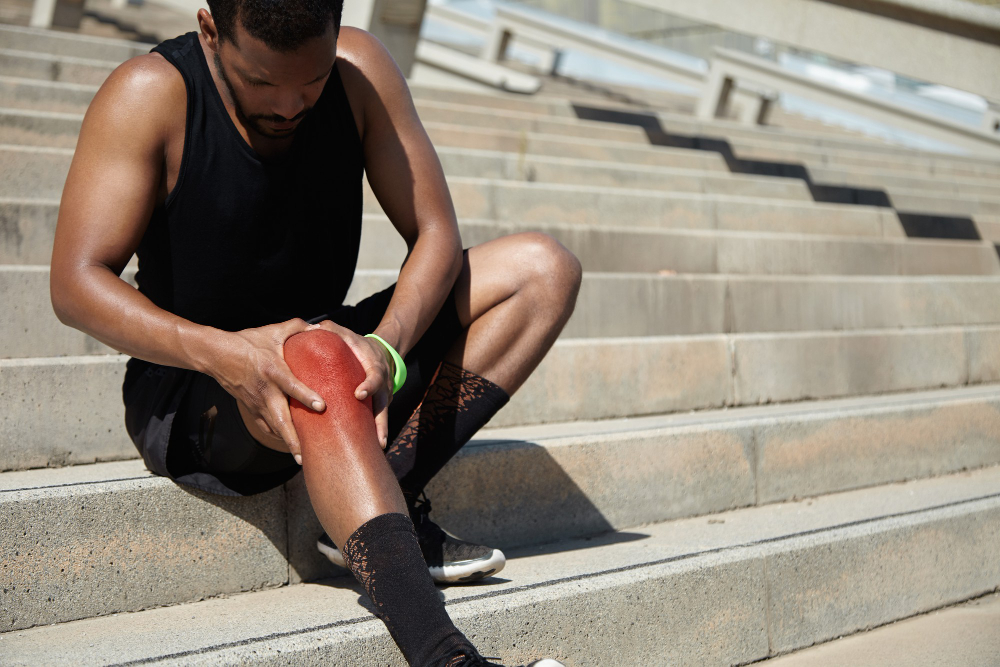
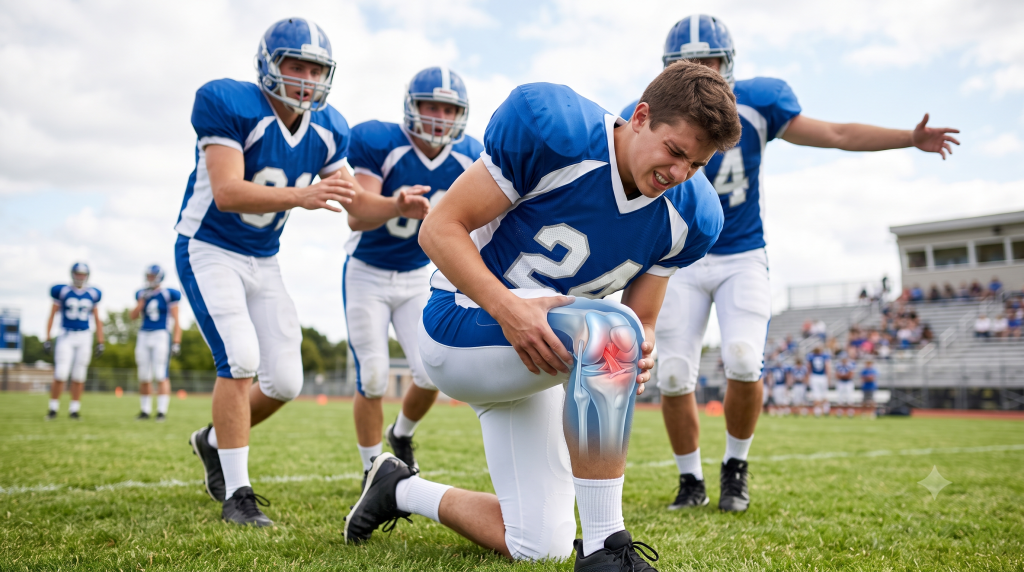
A 24-year-old football player was sprinting for the ball when he suddenly twisted his knee and went down. He heard a loud pop. Within an hour, his knee had swelled up like a balloon. He assumed it was just a bad sprain and rested at home for a week.
By the time he walked into our clinic, his knee had already started giving way while climbing stairs. This is one of the most common stories we hear from patients with ligament injuries. Catching the signs early could have changed his entire recovery timeline.
What Are the Early Signs of an ACL or PCL Injury?
Early signs of an ACL or PCL injury include a loud pop at the time of injury, rapid knee swelling, a feeling of the knee “giving way,” pain while walking or climbing stairs, and reduced knee movement. These symptoms usually appear within minutes to hours after a twisting or direct-impact injury during sports or a fall.
If you notice these signs, avoid walking on the injured leg and consult an orthopedic surgeon as soon as possible
What Are ACL and PCL Ligaments?
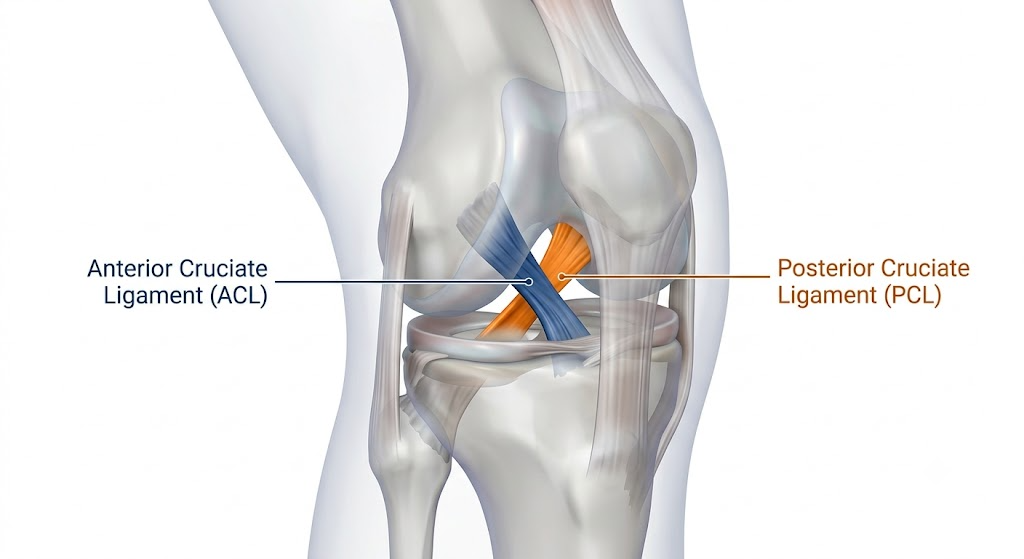
Your knee has four main ligaments that hold the joint together. Two of them, the ACL and PCL, sit in the center of the knee and cross each other like an X. That’s why they’re called cruciate ligaments.
The ACL (Anterior Cruciate Ligament) stops your shinbone from sliding too far forward. It’s the ligament most often injured during sports that involve sudden stops, pivots, or jumps, like football, cricket, and badminton.
The PCL (Posterior Cruciate Ligament) stops your shinbone from sliding too far backward. PCL injuries are less common and usually happen from a direct blow to the front of the knee, like hitting the dashboard in a car accident or falling hard on a bent knee.
Both ligaments keep your knee stable during running, jumping, and changing direction. When either one tears, the knee loses its stability.
Why Early Diagnosis Matters?
Many patients delay treatment because the pain sometimes reduces after a few days. This is misleading. The ligament damage is still there even if the pain settles down.
Delayed diagnosis can lead to repeated episodes of the knee giving way, which damages the cartilage and meniscus inside the joint over time. Research shows osteoarthritis develops in about 50% of ACL-injured knees within 10 to 20 years, especially when treatment is delayed or skipped.
Early diagnosis means:
- Better chances of a full recovery
- Less damage to cartilage and meniscus
- Lower risk of long-term arthritis
- Avoiding emergency or complicated surgery later
- A faster, more predictable return to sport
10 Early Signs of ACL or PCL Injury
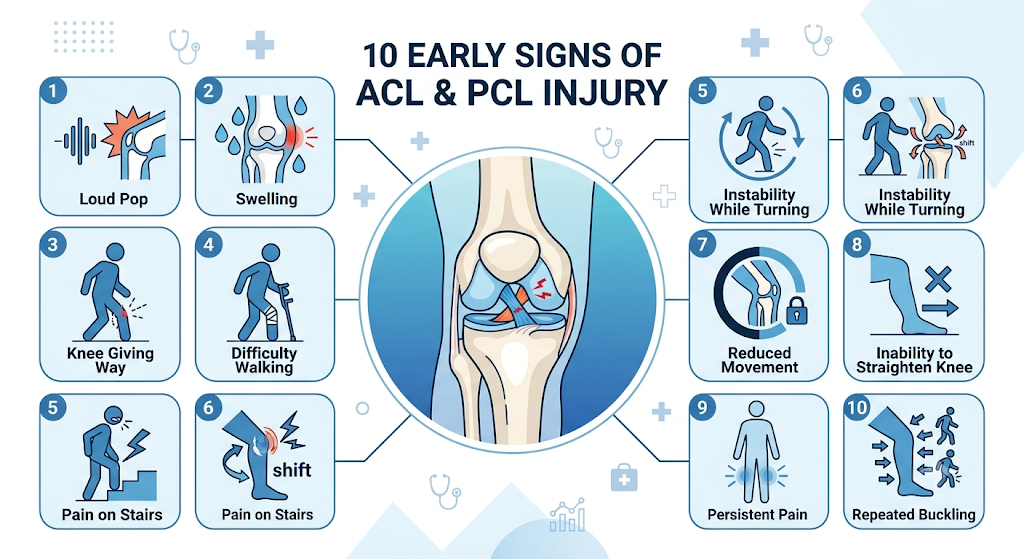
1. Loud Pop During Injury
Many patients describe hearing or feeling a distinct “pop” at the exact moment of injury. This happens when the ligament fibers tear suddenly under stress, usually during a twist, pivot, or awkward landing.
When to consult a doctor: If you heard a pop and your knee feels unstable afterward, get it examined within 24 to 48 hours.
2. Rapid Knee Swelling
Swelling that appears within a few hours of injury, not days, is a red flag. This happens because a torn ligament often bleeds into the joint, a condition doctors call hemarthrosis.
Possible cause: Fast, painful swelling almost always points to internal joint damage, not a simple sprain.
3. Knee Giving Way
This is one of the clearest signs of ligament injury. Patients often say their knee “buckled” or “gave out” while walking, turning, or standing on one leg.
Why it happens: Without the ACL or PCL holding the joint steady, the knee loses control during movement.
4. Difficulty Walking
Some patients can bear weight right after injury; others cannot take a single step. Either way, an altered walking pattern, like limping or avoiding full weight on the leg, suggests something deeper than a muscle strain.
What patients feel: A sense that the knee “isn’t trustworthy” even when pain is mild.
5. Pain While Climbing Stairs
Stairs put extra stress on the knee ligaments, especially going down. Persistent pain on stairs days or weeks after injury often means the ligament hasn’t healed on its own.
When to consult a doctor: If stair pain continues beyond one week, it needs evaluation.
6. Knee Instability During Turning
A knee that feels wobbly or unstable specifically during pivoting or turning movements is a hallmark ACL symptom. This is common in sports like badminton, football, and cricket, where quick direction changes are frequent.
7. Reduced Range of Motion
Swelling and pain often make it hard to fully bend or straighten the knee. This stiffness can appear within the first day and may worsen if left untreated.
Why it happens: The joint protects itself by limiting movement when there’s internal damage.
8. Difficulty Straightening Knee
Struggling to fully extend the knee, especially combined with a locking sensation, can indicate a torn ligament along with meniscus involvement. This symptom often gets worse, not better, without treatment.
9. Persistent Pain After Sports Injury
Ordinary sprains usually improve steadily within a week. If pain persists, comes and goes, or worsens with activity two to three weeks after a sports injury, it’s a sign the injury may be more serious than a sprain.
10. Repeated Knee Buckling
If your knee has given way more than once, even during simple activities like walking on uneven ground, this points to chronic ligament instability. Repeated buckling episodes significantly raise the risk of further cartilage and meniscus damage.
Possible cause: An untreated or partially healed ACL or PCL tear.
ACL vs PCL Injury Symptoms
| Symptom | ACL Injury | PCL Injury |
| Common cause | Twisting, pivoting, jumping | Direct blow to front of knee |
| Pop sound | Very common | Less common |
| Swelling speed | Rapid, within hours | Can be slower, more subtle |
| Instability direction | Knee gives way while turning | Knee feels unstable going downstairs |
| Common sports | Football, cricket, badminton | Car accidents, falls on bent knee |
| Pain location | Front and center of knee | Back of knee |
Normal Knee Sprain vs ACL/PCL Injury
| Feature | Normal Sprain | ACL/PCL Injury |
| Swelling | Mild, gradual | Rapid, significant |
| Pop at time of injury | Rare | Common |
| Recovery in 1–2 weeks | Usually yes | Usually no |
| Knee giving way | Rare | Common |
| Weight-bearing | Mostly possible | Often difficult |
When to Visit an Orthopedic Surgeon in Indore?
| Symptom Severity | Action Needed |
| Mild pain, no swelling, no instability | Rest, monitor for 48 hours |
| Swelling within hours + pain | See a doctor within 1–2 days |
| Loud pop + inability to bear weight | Seek urgent orthopedic evaluation |
| Knee giving way repeatedly | Consult a sports injury specialist promptly |
Symptom Severity Timeline
Time of Injury
↓
Pop or twist felt → Immediate pain
↓
0–6 hours: Rapid swelling begins
↓
6–24 hours: Stiffness, reduced movement
↓
1–2 weeks: Instability during walking/stairs
↓
Untreated: Repeated buckling, cartilage damage risk
How Common Are These Injuries?
According to the American Academy of Orthopaedic Surgeons, ACL tears affect more than 200,000 people annually in the U.S. and represent more than 50% of all knee injuries. Around 400,000 ACL reconstruction surgeries are performed each year in the United States alone.
Women have a notably higher risk of ACL injury than men in sports involving pivoting and jumping, such as basketball and soccer. This makes awareness especially important for female athletes and gym-goers.
Diagnosis
Physical Examination: We check knee stability, swelling, and range of motion. Two special tests help confirm ligament injury:
- Lachman Test: Checks for ACL looseness by gently moving the shinbone forward
- Posterior Drawer Test: Checks for PCL looseness by gently pushing the shinbone backward
Imaging:
- X-ray: Rules out fractures, doesn’t show ligaments directly
- MRI: The gold standard for diagnosing ACL and PCL tears. MRI detects ligament tears with 86 to 97% accuracy, making it far more reliable than physical exams alone.
- CT Scan: Occasionally used for complex fractures alongside ligament injury
Treatment
Treatment depends on how severe the tear is and how active you are.
Non-surgical approach (partial tears, low-demand patients):
- RICE (Rest, Ice, Compression, Elevation) in the first 48–72 hours
- Physiotherapy to strengthen surrounding muscles
- Bracing for added stability
- PRP (Platelet-Rich Plasma) therapy in select cases
Surgical approach (complete tears, athletes, active individuals):
- Arthroscopy: minimally invasive keyhole surgery
- ACL reconstruction: rebuilding the ligament using a tendon graft
- PCL reconstruction: similar technique for posterior ligament tears
- Structured rehabilitation over several months for full recovery
Prevention Tips
- Warm up properly before sports or gym sessions
- Strengthen quadriceps, hamstrings, and core muscles
- Practice proper landing and pivoting technique
- Wear supportive, sport-appropriate footwear
- Don’t play through knee pain, rest and reassess instead
- Get periodic screening if you play competitive or contact sports
When Should You Visit an Orthopedic Surgeon in Indore?
See a sports injury specialist in Indore right away if you notice:
- A loud pop followed by immediate swelling
- Inability to bear weight on the injured leg
- Your knee repeatedly giving way
- Persistent pain lasting more than a week after injury
- Locking or inability to fully straighten the knee
Ligament injuries rarely announce themselves loudly after the first day. The early signs, a pop, swelling, instability, are easy to dismiss as “just a sprain.” But catching them early makes a real difference in how well and how quickly your knee recovers.
If you’ve experienced any of these symptoms after a sports injury, fall, or twist, it’s worth getting your knee properly evaluated. Dr. Tarkit Modi, an experienced orthopedic surgeon in Indore, can help you understand exactly what’s going on and guide you toward the right treatment for ACL or PCL injury.
FAQs
What are the early signs of ACL injury?
Early signs include a loud pop at the time of injury, rapid swelling within hours, a feeling of the knee giving way, and pain while walking or climbing stairs. These symptoms usually appear within the first 24 hours after a twisting sports injury.
How do I know if I tore my ACL or PCL?
The clearest signs are sudden swelling, instability, and difficulty bearing weight after a twisting or direct-impact injury. A definite diagnosis requires a physical exam by an orthopedic surgeon along with an MRI scan.
Can a PCL injury heal without surgery?
Mild to moderate PCL injuries often heal well with physiotherapy, bracing, and rest, especially in less active individuals. Complete tears or injuries affecting daily activity and sports usually require surgical reconstruction.
What does a popping sound in the knee mean?
A popping sound during an injury often indicates a ligament tear, most commonly the ACL. It happens when ligament fibers snap under sudden stress during twisting, jumping, or pivoting movements.
How long does ACL surgery recovery take?
Most patients need 6 to 9 months of structured rehabilitation before returning to competitive sports. Recovery timelines vary based on graft type, injury severity, and how consistently physiotherapy is followed.
Can I walk with a torn ACL?
Some people can walk with a torn ACL, especially with a partial tear, but the knee often feels unstable. Walking on an untreated torn ACL increases the risk of further cartilage and meniscus damage.
Is swelling always present in ACL or PCL injury?
Not always, but rapid swelling within a few hours strongly suggests ligament injury involving internal bleeding in the joint. Some PCL injuries swell more slowly or subtly than ACL injuries.
What is the difference between ACL and PCL injury?
ACL injuries usually happen from twisting or pivoting and cause the knee to give way during turns. PCL injuries usually result from a direct blow to the front of the knee and cause instability while going downstairs.
Do all ACL tears need surgery?
No. Partial tears in less active individuals may be managed with physiotherapy and bracing. Complete tears in athletes or physically active people usually benefit from surgical reconstruction for long-term stability.
How is an ACL or PCL injury diagnosed?
Diagnosis involves a physical exam using tests like the Lachman Test or Posterior Drawer Test, followed by an MRI scan. MRI is considered the gold standard because it clearly shows the extent of ligament damage.
Can ACL or PCL injuries be prevented?
While not always avoidable, risk can be reduced through proper warm-ups, strength training, correct landing technique, and not playing through knee pain. Structured sports-specific training programs also help lower injury risk.
When should I see an orthopedic surgeon in Indore for knee pain?
See a surgeon promptly if you experience a pop, rapid swelling, inability to walk normally, or repeated episodes of your knee giving way. Early evaluation prevents further joint damage and supports better long-term recovery.