

Last year, a 26-year-old cricket player from Indore twisted his knee during a friendly match. The pain was sharp, but he walked it off and assumed it was just a sprain. Three days later, his knee was severely swollen and unstable, and he could barely stand.
By the time he visited an orthopaedic surgeon, he had a complete ACL tear, an injury that could have been treated far more effectively if addressed within the first 48 hours.
This story is far too common. Whether you play cricket, football, or basketball, hit the gym daily, or simply go for a morning run, sports injuries can happen to anyone, at any age, at any fitness level.
The real problem is not the injury itself. It is not knowing when to take it seriously.
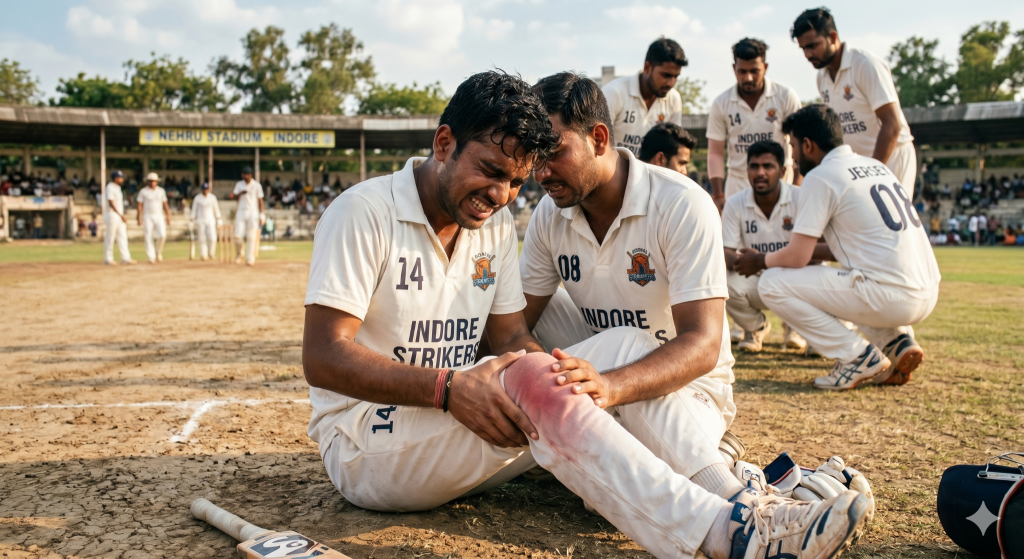
What Sports Injury Symptoms Require Immediate Medical Attention?
Sports injury symptoms that require immediate medical attention include severe swelling that worsens rapidly, inability to bear weight or move a joint, a popping or cracking sound at the time of injury, visible deformity of a limb or joint, numbness or tingling in the injured area, intense pain that does not reduce with rest, and any loss of sensation or muscle weakness.
These are warning signs that indicate a possible fracture, ligament tear, nerve damage, or joint dislocation, all of which need urgent evaluation by an orthopaedic surgeon.
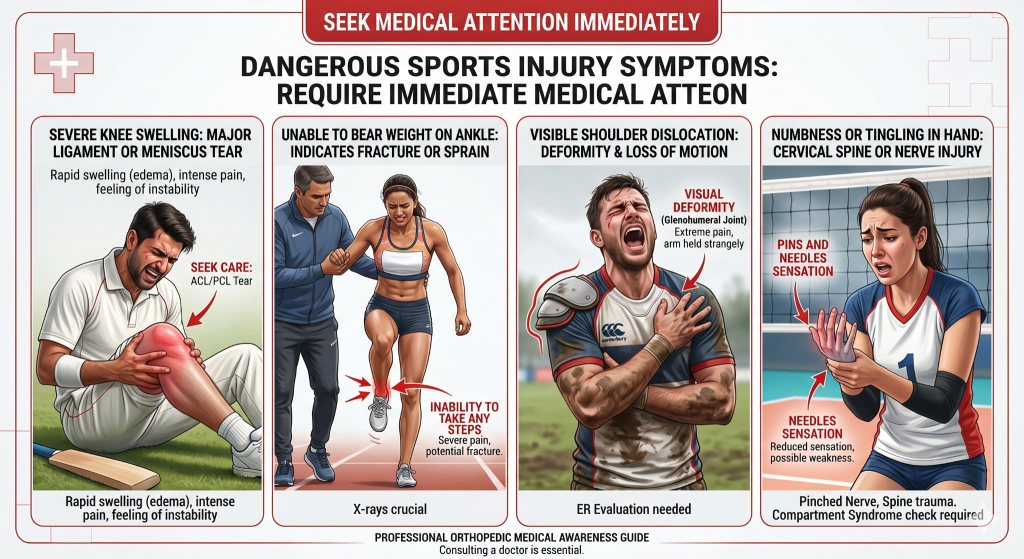
Common Sports Injuries in India – Why Awareness Matters?
Sports injuries are rising in India. According to a study published in the Indian Journal of Orthopaedics, knee and ankle injuries account for over 45% of all sports-related orthopedic consultations.
In Indore, with a rapidly growing fitness and sports culture, orthopedic doctors are seeing more young patients with delayed treatment simply because they did not recognise serious symptoms early enough.
The most common sports injuries include:
- Ligament tears (especially ACL injuries in the knee)
- Ankle sprains
- Muscle tears and strains
- Stress fractures
- Shoulder dislocations
- Tendon injuries
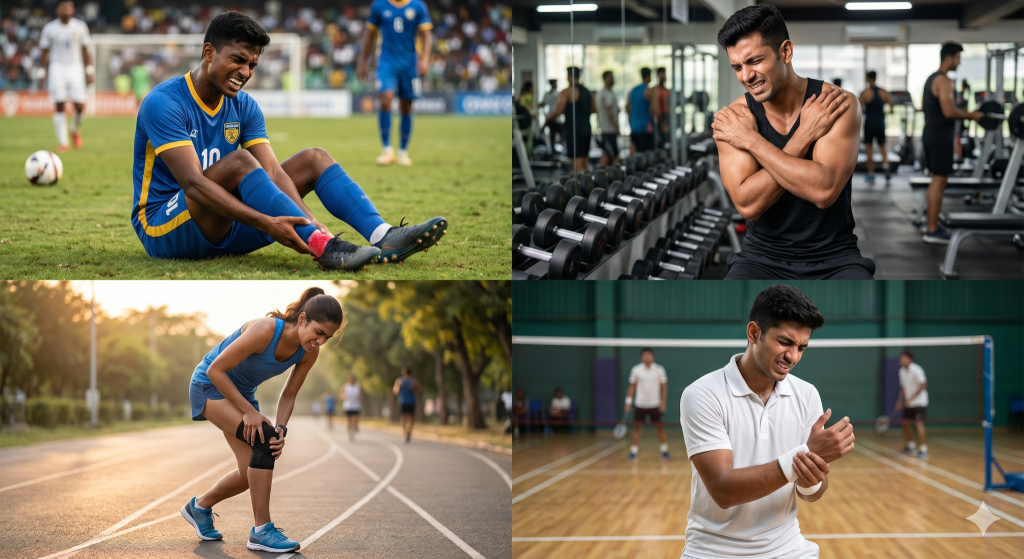
Symptoms You Should Never Ignore After a Sports Injury
This is the most critical section. These symptoms are not “wait and watch” situations; they need same-day or emergency orthopedic care.
1. A Loud Pop or Snap at the Time of Injury If you heard or felt a popping sound when you got hurt, especially in the knee or ankle, this strongly suggests a ligament rupture. ACL injury symptoms often begin with exactly this sensation, followed by immediate swelling and instability.
2. Severe Swelling Within Minutes. Normal sprains cause mild swelling for hours. If your joint swells rapidly and feels tight within the first 15–30 minutes, this could indicate internal bleeding, a fracture, or a complete ligament tear. Do not ignore this.
3. Inability to Bear Weight. If you cannot stand, walk, or put weight on the injured leg, foot, or ankle, this is a serious fracture symptom after a sports injury. Trying to “push through it” risks further damage.
4. Visible Deformity Any abnormal shape, angle, or protrusion at the injured site is a clear sign of fracture or dislocation. This is always an orthopedic emergency.
5. Numbness, Tingling, or Weakness Numbness after a sports injury is often overlooked. But tingling, loss of sensation, or sudden muscle weakness can signal nerve compression or damage, conditions that worsen rapidly without treatment.
6. Joint Instability If your knee, ankle, or shoulder feels like it will “give way” or move in an abnormal direction, ligaments may be severely damaged. This is a key ACL injury symptom and should not be self-managed.
7. Severe Pain That Does Not Reduce With Rest and Ice. Ordinary muscle soreness improves within 24–48 hours with rest. Pain that stays intense or worsens despite rest, ice, and elevation is not normal — it needs professional evaluation.
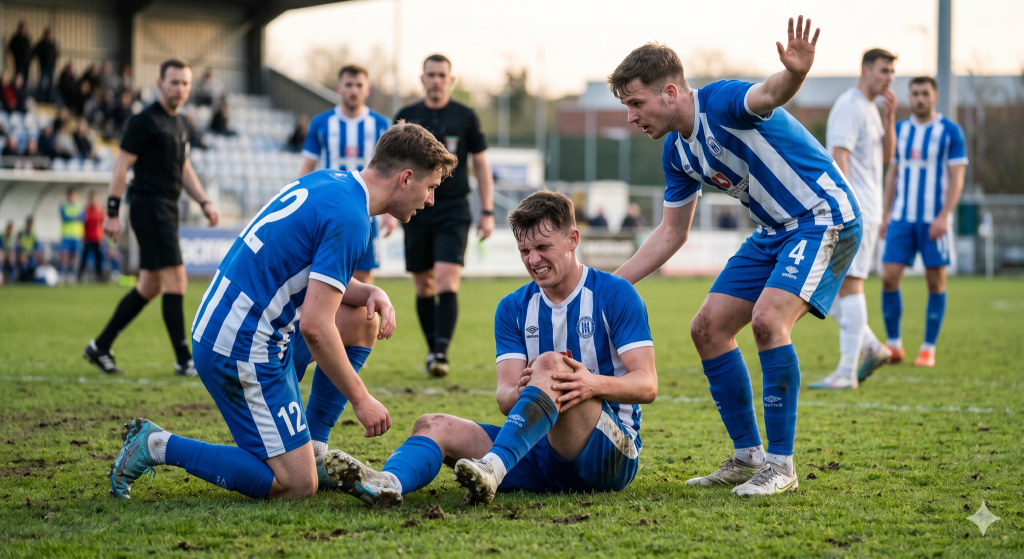
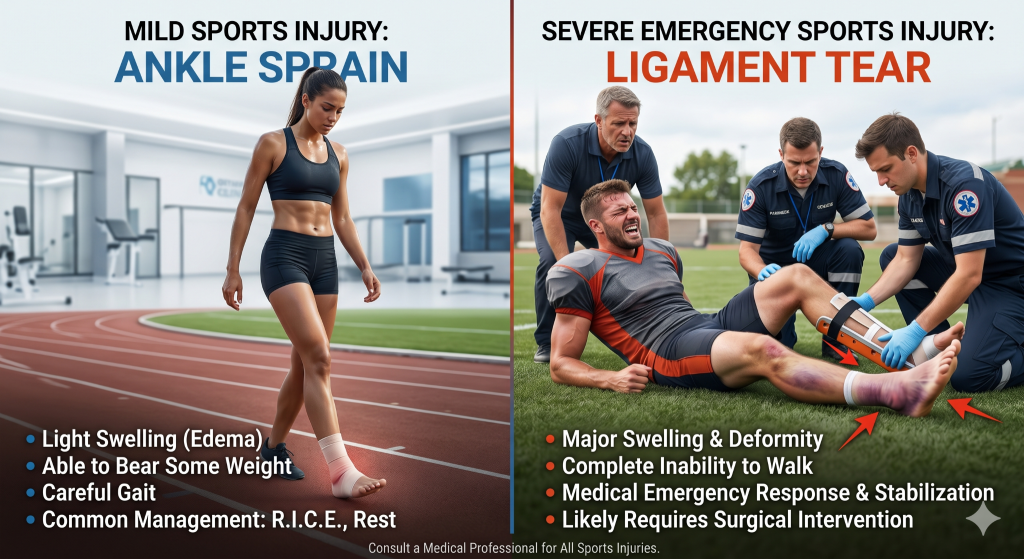
Mild Injury vs. Emergency Injury — How to Tell the Difference
| Symptom | Mild / Wait and Watch | Emergency — See a doctor immediately |
| Swelling | Mild, appears slowly after hours | Rapid, severe swelling within minutes |
| Pain | Dull ache, improves with rest | Intense pain, does not reduce with rest |
| Movement | Restricted but possible | Impossible or extremely painful |
| Bearing weight | Slightly uncomfortable | Completely unable to stand or walk |
| Appearance | Normal shape and skin | Visible deformity or bruising |
| Sensation | Normal | Numbness, tingling, or weakness |
| Sound at injury | None | Pop, crack, or snapping sound |
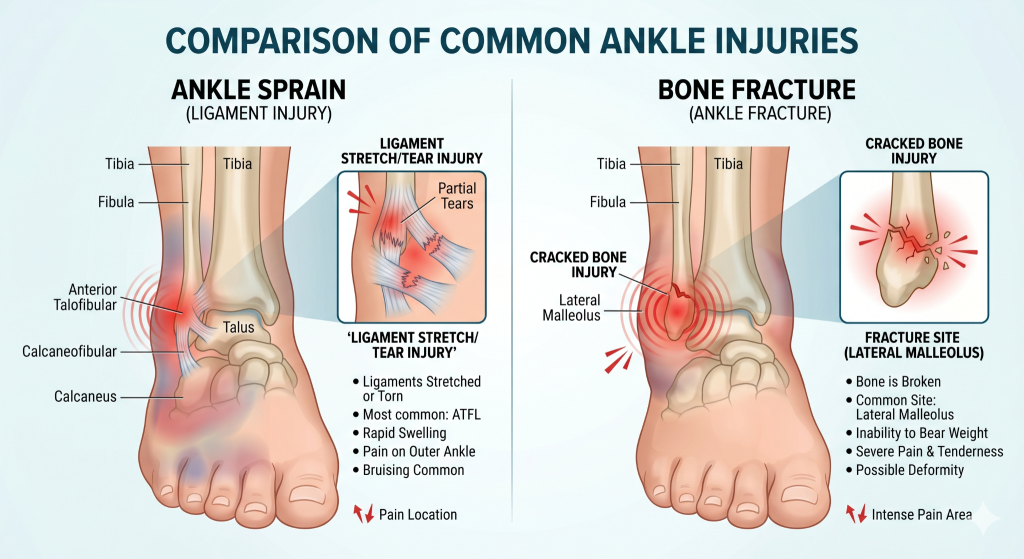
Sprain vs. Fracture: A Practical Guide
Many people confuse a sprain with a fracture after a sports injury. Both cause pain and swelling but their severity and treatment differ significantly.
| Feature | Sprain (Ligament Injury) | Fracture (Bone Injury) |
| Cause | Overstretching or tearing of the ligament | Direct impact or excessive force on the bone |
| Pain | Around the joint | Directly over the bone |
| Swelling | Moderate, gradual | Rapid, intense |
| Bruising | May appear after hours | Often immediate and significant |
| Movement | Painful but partially possible | Extremely limited or impossible |
| Weight bearing | Painful but sometimes possible | Usually impossible |
| Diagnosis | MRI or physical examination | X-ray or CT scan |
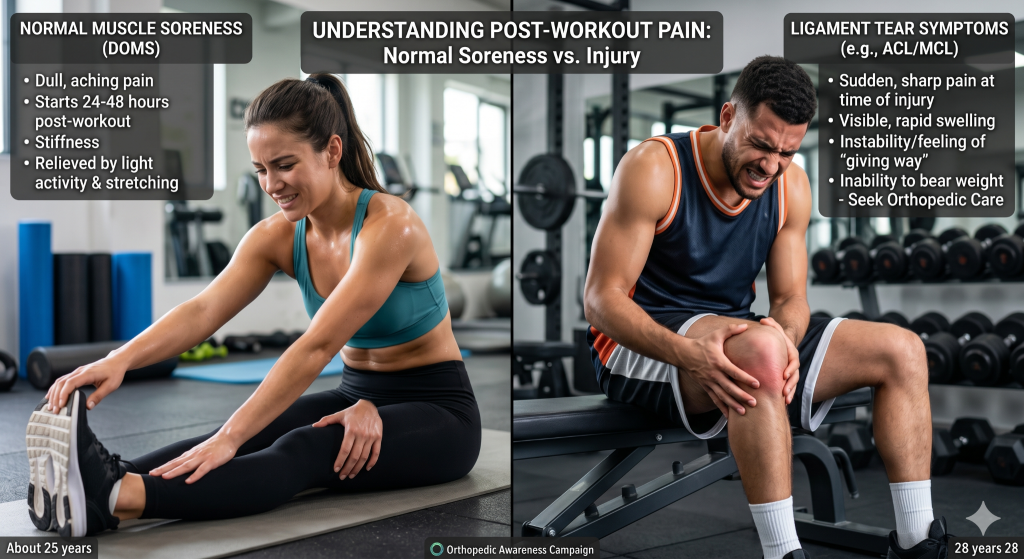
Muscle Soreness vs. Ligament Tear- Know the Difference
Normal post-workout muscle soreness (called DOMS — Delayed Onset Muscle Soreness) peaks at 24–72 hours and gradually fades. Ligament tear symptoms are different:
- Pain is localised to a specific joint, not a muscle group
- Swelling is present at the joint
- There is joint instability or a feeling of looseness
- Pain does not improve with 2–3 days of rest
- There may have been a specific moment of injury — a twist, fall, or collision
Muscle soreness is normal. Joint-specific pain with swelling and instability after a sports incident is not, and needs evaluation.
When Should You Visit an Orthopaedic Surgeon in Indore?
You should see an orthopaedic surgeon or sports injury doctor in Indore if:
- You heard a pop or crack during the injury
- Swelling developed rapidly within the first hour
- You cannot move the joint fully or bear weight
- Pain has not improved after 48–72 hours of rest and home care
- You notice any numbness, tingling, or weakness
- You have had a previous injury to the same area, and it feels similar or worse
- You are an athlete who needs to return to sport safely and quickly
How Sports Injuries Are Diagnosed?
At an orthopaedic clinic, your doctor will use a combination of:
- Physical Examination: assessing range of motion, stability, swelling, and tenderness
- X-ray: to identify fractures and bone misalignment
- MRI Scan: the gold standard for detecting ligament tears, ACL injuries, and soft tissue damage
- CT Scan: for complex fractures requiring detailed bone imaging
Treatment Options for Sports Injuries
Non-Surgical Treatment (for mild to moderate injuries):
- RICE method — Rest, Ice, Compression, Elevation
- Physiotherapy and rehabilitation exercises
- Anti-inflammatory medications
- Bracing or taping for support
- Platelet-Rich Plasma (PRP) therapy for ligament and tendon injuries
Surgical Treatment (for severe cases):
- ACL reconstruction for complete ligament tears
- Fracture fixation with plates, screws, or rods
- Arthroscopic surgery for joint damage
- Shoulder stabilisation surgery for recurrent dislocations
Surgical treatment is recommended only when non-surgical methods are insufficient, and your orthopedic surgeon will guide this decision based on your specific diagnosis.
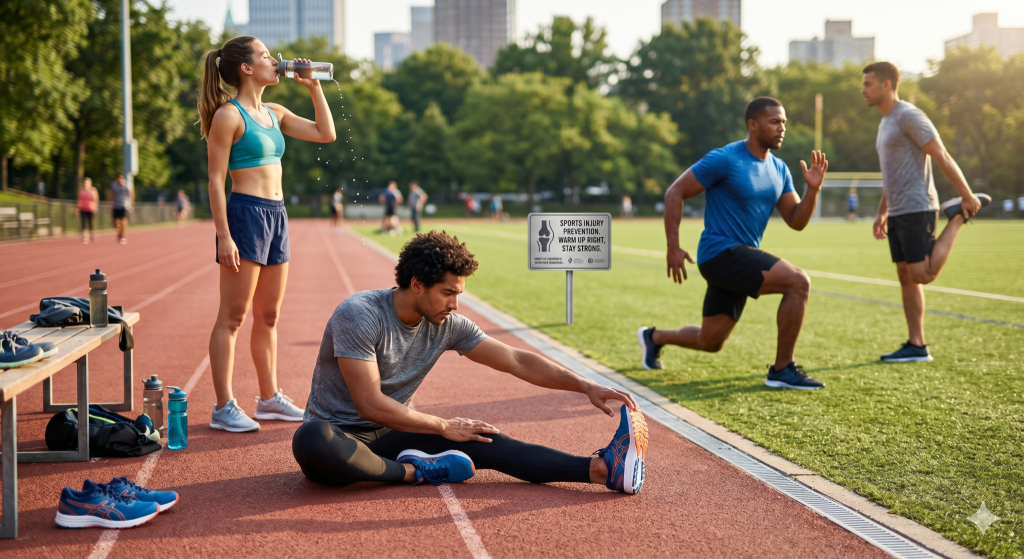
Practical Prevention Tips for Athletes and Fitness Enthusiasts
- Always warm up for at least 10 minutes before exercise or sport
- Strengthen muscles around vulnerable joints (knees, ankles, shoulders)
- Wear proper footwear for your sport or activity
- Do not ignore minor pain; address it before it becomes a major injury
- Learn and use the correct technique, especially for weightlifting and contact sports
- Allow adequate recovery time between intense training sessions
- Stay hydrated and maintain good nutrition to support muscle and ligament health
Sports injuries are common but not all of them are minor. Recognising the difference between a normal strain and a serious orthopaedic injury can protect you from long-term damage, prolonged recovery, and permanent complications.
If you or someone you know is experiencing any of the warning symptoms mentioned above do not wait and see. Early intervention leads to better outcomes, faster recovery, and a safer return to your sport or fitness routine.
Dr. Tarkit Modi is an experienced orthopedic surgeon, specializing in sports injury treatment, ligament injuries, fracture management, and advanced arthroscopic procedures. Whether you are a professional athlete, a weekend cricketer, or a gym-goer, Dr Modi provides accurate diagnosis and personalized treatment plans tailored to your injury and lifestyle.
Book your consultation with Dr. Tarkit Modi in Indore today because the right care at the right time makes all the difference.
Frequently Asked Questions (FAQs)
How do I know if a sports injury is serious?
A sports injury is serious if you experience rapid swelling, inability to bear weight, a popping sound at the time of injury, visible deformity, numbness or tingling, or joint instability. These symptoms suggest a fracture, ligament tear, or nerve involvement and require immediate evaluation by an orthopedic surgeon.
When should I go to the doctor for a sports injury?
You should see a doctor immediately if pain is severe and not improving, swelling is rapid and significant, you cannot move the joint or walk, or you felt a pop or crack at the time of injury. Do not wait more than 48–72 hours for any sports injury that does not clearly improve with rest.
What symptoms indicate a torn ligament?
Ligament tear symptoms include a popping sensation at the time of injury, rapid swelling around the joint, feeling of instability or joint giving way, localized tenderness, and difficulty bearing weight. ACL injury symptoms in the knee specifically include swelling within hours and the knee feeling unstable during movement.
Can swelling after a sports injury be dangerous?
Yes. Rapid, severe swelling within minutes of a sports injury can indicate internal bleeding, a fracture, or a complete ligament rupture — all of which need urgent medical attention. Mild swelling that develops gradually is less concerning but should still be monitored.
What are red flag symptoms after a sports injury?
Red flag symptoms include visible bone deformity, inability to move the joint, numbness or weakness in the limb, intense pain that worsens with rest, rapid swelling, and a popping or cracking sound during injury. Any of these warrant same-day consultation with an orthopedic surgeon.
What is the best treatment for a sports injury in Indore?
Treatment depends on the type and severity of injury. Mild injuries respond well to rest, physiotherapy, and medication. Severe injuries like ACL tears or fractures may require surgical intervention. Dr. Tarkit Modi, a sports injury doctor in Indore, provides both non-surgical and surgical treatment options with personalized care.
How long does recovery from a sports injury take?
Recovery time varies by injury type. Mild sprains typically heal in 2–6 weeks. Ligament tears may take 3–6 months with physiotherapy. ACL reconstruction surgery requires 6–9 months of rehabilitation before return to sport. Early and accurate diagnosis significantly shortens overall recovery time.