

You woke up one morning and felt it a sharp, shooting pain starting from your lower back, travelling down your leg. It hurts to sit. It hurts to stand. It even hurts to lie down in certain positions.
If this sounds familiar, you are probably dealing with sciatica. The first question most people ask me at my clinic is this: “Doctor, will it go away on its own? Do I really need treatment?”
It is a fair question. And the honest answer is sometimes yes, sometimes no. It depends on the cause and how you manage it.

What is Sciatica?
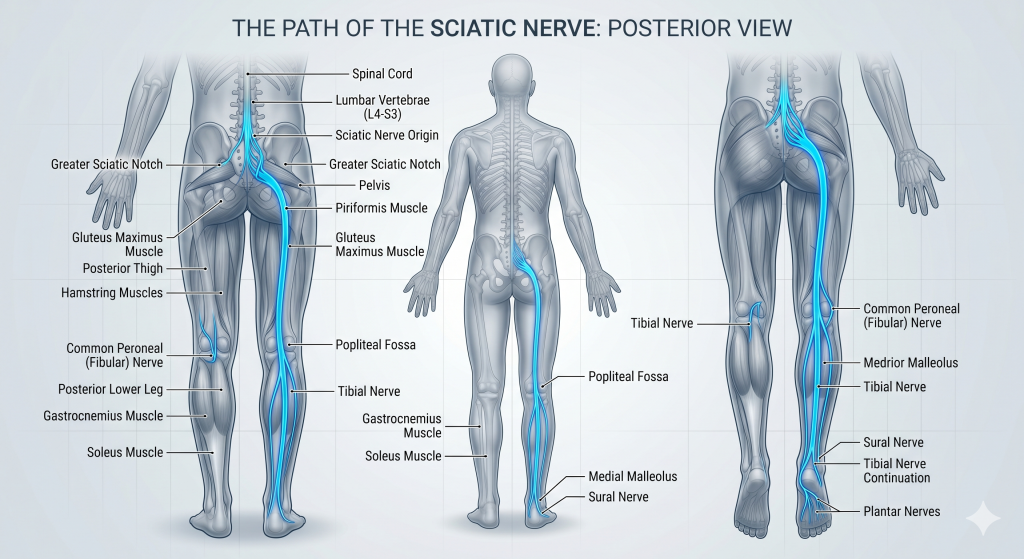
Sciatica is not a disease. It is a symptom. It refers to pain that travels along the path of the sciatic nerve, the longest nerve in your body. This nerve starts in your lower back, runs through your hips and buttocks, and goes all the way down each leg.
When something compresses or irritates this nerve, you feel pain, numbness, tingling, or weakness along its path. That is sciatica. It typically affects one side of the body at a time.
Can Sciatica Go Away on Its Own?
Yes, mild to moderate sciatica often does improve on its own, without surgery or aggressive treatment. Research supports this. Studies show that approximately 60 to 70 percent of sciatica patients see significant improvement within 6 to 12 weeks with conservative care like rest, gentle movement, and basic pain management.
However, this does not mean you should simply ignore it and hope for the best. Sciatica caused by a small herniated disc or minor nerve irritation has a good chance of resolving naturally. But sciatica caused by spinal stenosis, a more serious disc problem, or structural issues is unlikely to disappear without proper medical attention.
The key is knowing which type you have and that requires a proper diagnosis from a qualified orthopedic in Indore or wherever you are located.

Typical Recovery Timeline
Understanding what to expect helps reduce anxiety.
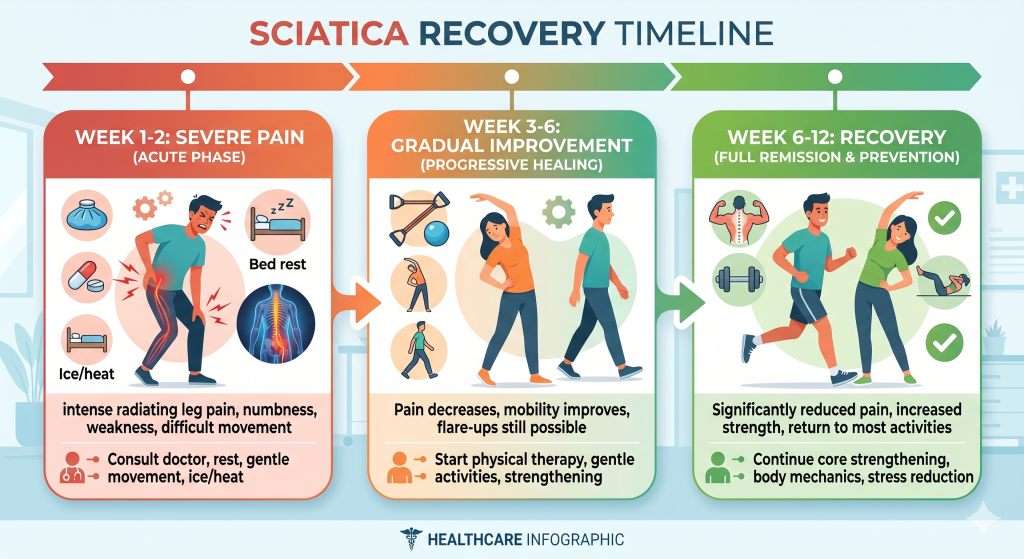
Week 1 to 2: Pain is often at its worst. Rest, anti-inflammatory medication, and hot or cold therapy are typically recommended.
Week 3 to 6: Many patients begin to notice gradual improvement. Physiotherapy exercises usually begin during this phase.
Week 6 to 12: Most mild cases show significant or complete relief by this point.
Beyond 12 weeks: If pain persists beyond three months, it is classified as chronic sciatica. At this stage, further investigation and a structured treatment plan are strongly advised.
Common Causes of Sciatica
Understanding the cause is the first step toward the right treatment.
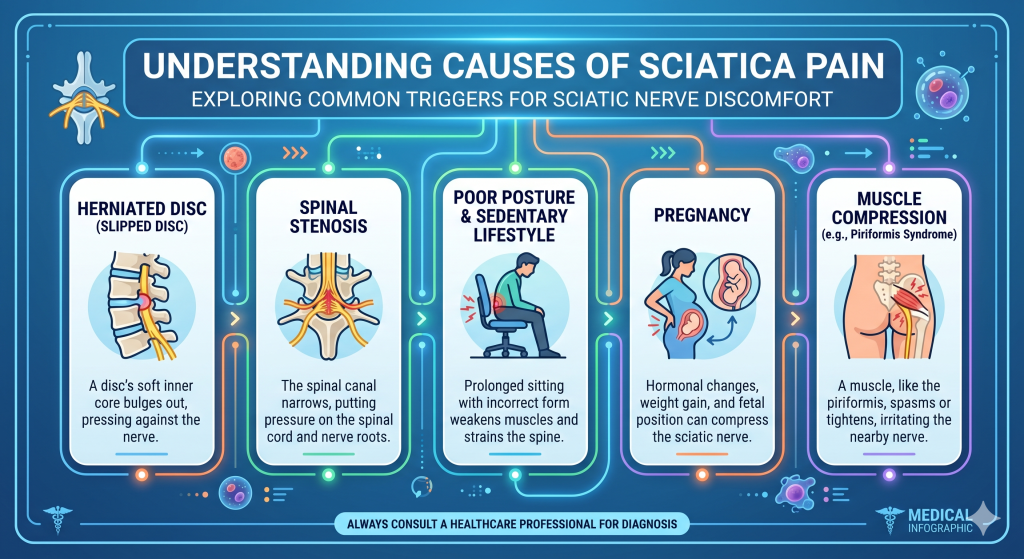
- Herniated or slipped disc : the most common cause, where disc material presses on the nerve
- Lumbar spinal stenosis: narrowing of the spinal canal, more common in people over 50
- Piriformis syndrome: A muscle in the buttocks compresses the sciatic nerve
- Spondylolisthesis: one vertebra slips forward over another
- Prolonged sitting or poor posture: very common among desk workers and drivers in Indore and other urban areas
- Pregnancy: the growing uterus can press on the sciatic nerve
Symptoms You Should Not Ignore
Sciatica presents differently in different people. Common symptoms include:
- Sharp or burning pain in the lower back, buttock, or leg
- Pain that worsens when sitting for long periods
- Numbness or tingling down one leg
- Muscle weakness in the affected leg or foot
- Difficulty standing up from a seated position
Seek immediate medical attention if you experience:
- Loss of bladder or bowel control
- Severe weakness or numbness in both legs
- Pain following a sudden injury or accident
These can indicate a serious spinal emergency called cauda equina syndrome, which requires urgent care.
Treatment Options: Conservative vs. Medical
| Treatment Type | Examples | Best For |
| Rest and activity modification | Avoiding triggers, short rest periods | Acute phase (week 1–2) |
| Hot and cold therapy | Ice packs, warm compresses | Early pain relief |
| Physiotherapy | Stretching, nerve glide exercises | Weeks 2–8 |
| Medications | NSAIDs, muscle relaxants | Moderate pain management |
| Epidural steroid injections | Guided corticosteroid injection | Persistent nerve inflammation |
| Minimally invasive procedures | Microdiscectomy, endoscopic surgery | Structural causes not resolving |
| Open surgery | Discectomy, spinal fusion | Severe or long-standing cases |
When Should You Consult a Doctor?
Many people in Indore wait too long before seeking help. Do not make that mistake.
You should consult an orthopaedic surgeon if:
- Your pain has lasted more than 4 to 6 weeks without improvement
- The pain is severe and affecting your sleep or daily activities
- You notice increasing weakness or numbness in your leg
- Home remedies and over-the-counter medications are not providing relief
- You have a history of cancer, osteoporosis, or a recent spinal injury
Early diagnosis leads to better outcomes. A proper MRI or X-ray helps identify the exact cause and allows for a treatment plan that is specific to your condition.
Dr. Tarkit Modi is a highly experienced orthopedic surgeon in Indore with specialized expertise in spine conditions, including sciatica, disc herniation, and spinal stenosis.

Patients from across Madhya Pradesh visit Dr. Modi’s clinic for:
- Accurate diagnosis using advanced imaging
- Personalised, non-surgical treatment plans wherever possible
- Minimally invasive surgical options with faster recovery
- Clear, jargon-free communication so patients fully understand their condition
- Compassionate, patient-first approach at every stage of care
Whether you are experiencing your first episode of sciatica or dealing with a long-standing spine condition, Dr. Modi’s clinic offers trusted sciatica pain treatment in Indore tailored to your specific needs.
Take the First Step Toward Pain-Free Living
Sciatica can feel overwhelming. But with the right guidance, most people recover fully and return to normal life.
Do not wait for the pain to become unbearable. An early consultation can save you months of suffering and prevent the condition from becoming chronic.
Book your appointment with Dr. Tarkit Modi, orthopedic surgeon in Indore, today.
Frequently Asked Questions
Can sciatica go away permanently without treatment?
Mild sciatica caused by minor nerve irritation can resolve on its own within 6 to 12 weeks. However, sciatica caused by structural issues like spinal stenosis or significant disc herniation typically requires treatment to resolve fully.
How long does sciatica pain usually last?
Acute sciatica often improves within 4 to 12 weeks. If pain persists beyond 3 months, it is considered chronic and needs medical evaluation from an orthopedic specialist.
What is the fastest way to relieve sciatica pain?
A combination of rest, ice or heat therapy, gentle stretching, and anti-inflammatory medication tends to provide the fastest short-term relief. A physiotherapist can also guide you through specific nerve glide exercises.
Is walking good or bad for sciatica?
Gentle walking is generally beneficial. It keeps the spine mobile and promotes natural healing. Avoid prolonged sitting, which tends to worsen sciatica symptoms.
When is surgery needed for sciatica?
Surgery is considered when conservative treatment has failed after 3 to 6 months, or when there is significant nerve damage, muscle weakness, or loss of bladder and bowel control. Dr. Tarkit Modi always explores non-surgical options first.
What causes sciatica to flare up suddenly?
Common triggers include prolonged sitting, lifting heavy objects with poor posture, sudden twisting movements, and even sneezing or coughing forcefully. Identifying and avoiding your personal triggers is an important part of managing sciatica.
Is sciatica treatment in Indore available without surgery?
Yes. The vast majority of sciatica cases in Indore and elsewhere are successfully treated without surgery through physiotherapy, medication, and lifestyle modifications. Dr. Tarkit Modi’s clinic focuses on non-surgical solutions wherever clinically appropriate.