

Imagine this: Ramesh, a 42-year-old businessman from Indore, had been limping slightly for months. He blamed it on a long work trip. His wife noticed he had stopped sitting cross-legged during family meals. He brushed it off as “age catching up.”
Six months later, an MRI revealed he had advanced avascular necrosis of the hip.
This story is more common than you think.
Avascular necrosis (AVN) is a condition where the bone tissue starts dying because it is not getting enough blood supply. The hip joint is the most commonly affected area. And the most dangerous part? The early symptoms are so mild and so easy to ignore that most people visit a doctor only when the damage is already serious.
The good news is that if caught early, AVN can be managed well, and major surgery can often be avoided.

What Is Avascular Necrosis?
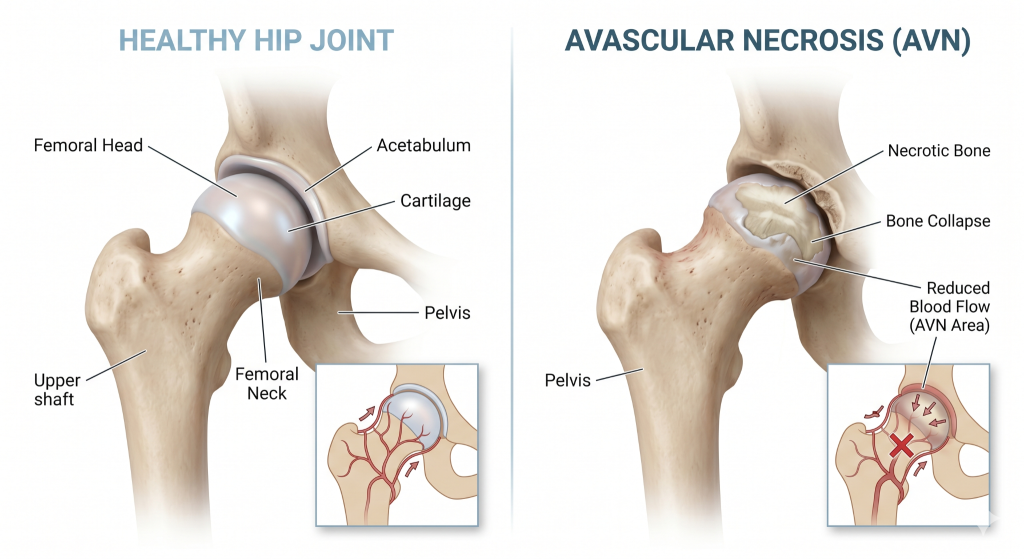
Avascular necrosis, also called osteonecrosis, happens when the blood supply to a bone is reduced or cut off. Without blood, the bone tissue begins to die slowly.
Think of it like a plant that is not getting water. At first, it wilts. Then, if nothing changes, it dies completely.
The hip is the most commonly affected joint. When the round head of the thigh bone (called the femoral head) loses its blood supply, it gradually weakens and can collapse. This leads to severe hip pain, loss of movement, and eventually, if untreated, the need for a total hip replacement.
AVN can also affect the knee, shoulder, and ankle, but hip involvement occurs in more than 90% of cases.

Why Early Diagnosis of AVN Matters?
Here is the hard truth/ AVN does not wait.
In the early stages, the bone is damaged but not yet collapsed. This is the window of opportunity. With the right treatment, the progression can be slowed or even stopped.
But once the femoral head collapses, the options become much more limited, often requiring total hip replacement surgery.
AVN commonly affects adults between 30 and 50 years of age, people who are active, working, and often too busy to pay attention to “minor” body aches.
Research shows that without treatment, about 70–80% of AVN cases progress to joint collapse within 2–3 years.
Early diagnosis means better outcomes. That is why recognising the early warning signs matters so much.
7 Early Symptoms of Avascular Necrosis Most People Ignore
1. Pain While Walking
This is one of the most common first signs of AVN hip, a dull ache or sharp pain felt deep in the groin area while walking.
Most people think it is a muscle pull or a groin strain. They apply pain relief gel and move on.
But if this groin pain keeps coming back, especially while walking or bearing weight, it could be the hip joint sending you a warning signal.

2. Hip Stiffness After Sitting
Have you noticed your hip feeling stiff and tight after sitting for a long time, in a car, at a desk, or during a long journey?
This morning stiffness or post-sitting stiffness is often dismissed as a “sedentary lifestyle problem.” But in AVN, stiffness happens because the joint is already inflamed and the bone is under stress.
3. Limping Without Realising It
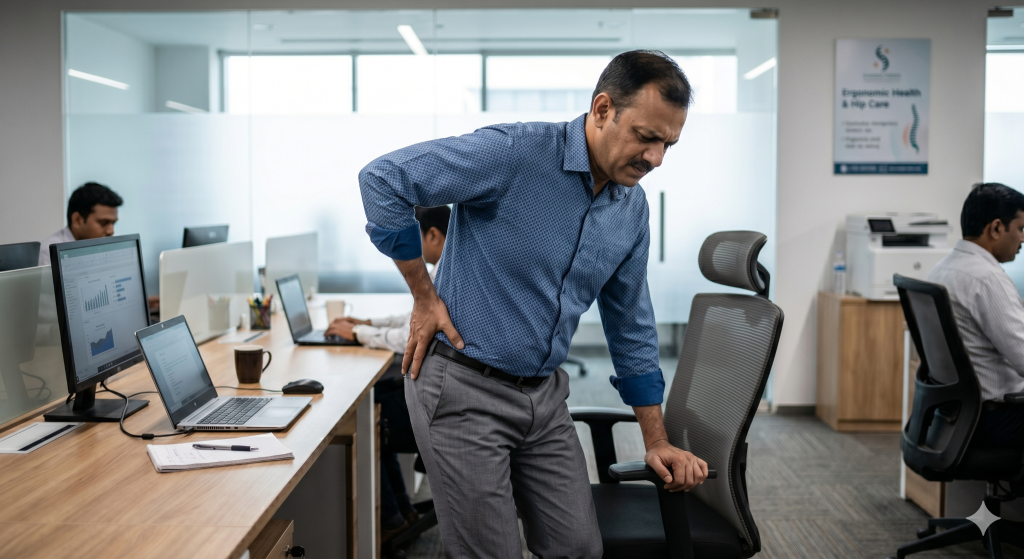
Many AVN patients are told by their family: “You have started limping” before they even realise it themselves.
The body is smart. It automatically shifts weight away from a painful joint. This creates a subtle limp often so mild that the person does not notice it.

4. Pain While Climbing Stairs
Climbing stairs puts significant pressure on the hip joint. In early AVN, this pressure triggers pain that is sharper than usual.
People often blame it on “knee pain” or “old age” and avoid stairs. But the real source of pain may be the hip, not the knee.

5. Reduced Hip Movement
Try rotating your leg outward while sitting. Or try crossing one leg over the other. If this feels restricted or painful, your hip movement may already be limited.
In healthy hips, movement is smooth and painless. In early AVN, the joint starts losing its normal range of motion, but so gradually that people adapt without realising it.
6. Pain That Increases at Night
Bone pain from AVN tends to get worse at rest, especially at night. Many patients report that their hip or thigh pain wakes them up from sleep.
Night pain is a serious sign. It usually means the problem is not just a muscular issue. Bone-related conditions like AVN are known to cause pain even without any physical activity.

7. Difficulty Sitting Cross-Legged
In India, sitting cross-legged (sukhasana or “aaram se baithna”) is part of daily life, during meals, prayers, and social gatherings.
If this simple position has become painful or impossible, your hip joint may be compromised. Loss of this specific movement is one of the earliest functional signs of AVN that Indian patients frequently report.

Common Causes and Risk Factors of AVN
Understanding what causes AVN can help you assess your own risk:
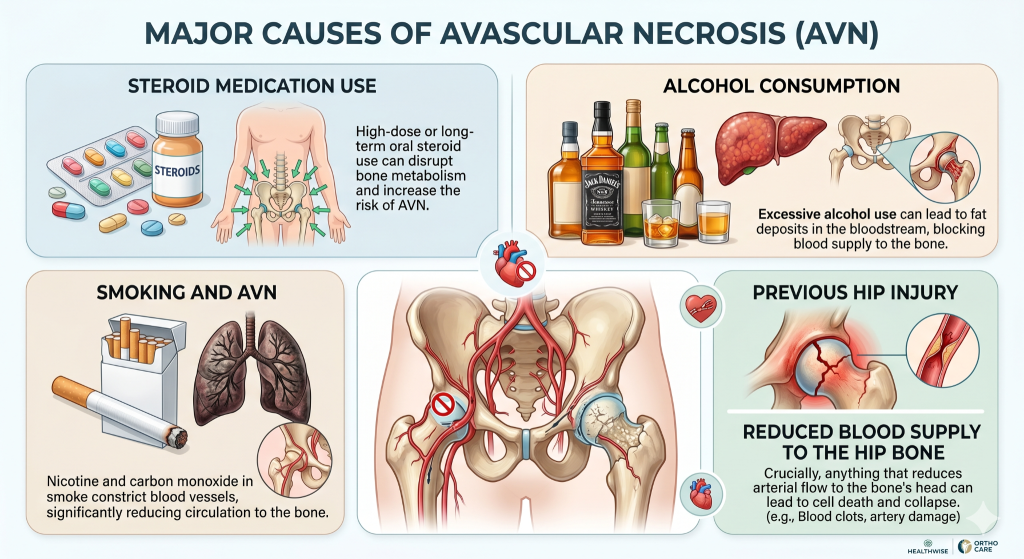
- Steroid use: Long-term use of corticosteroids (even prescribed ones) is one of the leading causes of AVN. This became especially relevant after the COVID-19 pandemic, when many patients received high-dose steroids during treatment. Post-COVID AVN cases have risen significantly since 2021.
- Alcohol consumption: Heavy, long-term alcohol use affects bone blood supply.
- Previous fractures or injuries: A hip fracture or dislocation can disrupt blood flow to the femoral head.
- Smoking: Reduces blood circulation throughout the body, including bones.
- Certain medical conditions: Sickle cell disease, lupus, and HIV are associated with higher AVN risk.
- Long-term medication use: Some chemotherapy drugs and immunosuppressants can also trigger AVN.
AVN Stages and Symptoms Comparison
| Stage | Symptoms | Joint Damage | Treatment Focus |
| Early (Stage 1–2) | Mild groin pain, slight stiffness | Minimal — bone weakening begins | Medicines, physiotherapy, activity changes |
| Moderate (Stage 3) | Clear limp, pain while walking and climbing stairs | Partial collapse of the femoral head | Core decompression, bone grafting |
| Advanced (Stage 4) | Severe pain, very limited movement | Full joint collapse | Total hip replacement surgery |
How Orthopaedic Surgeons Diagnose Avascular Necrosis?
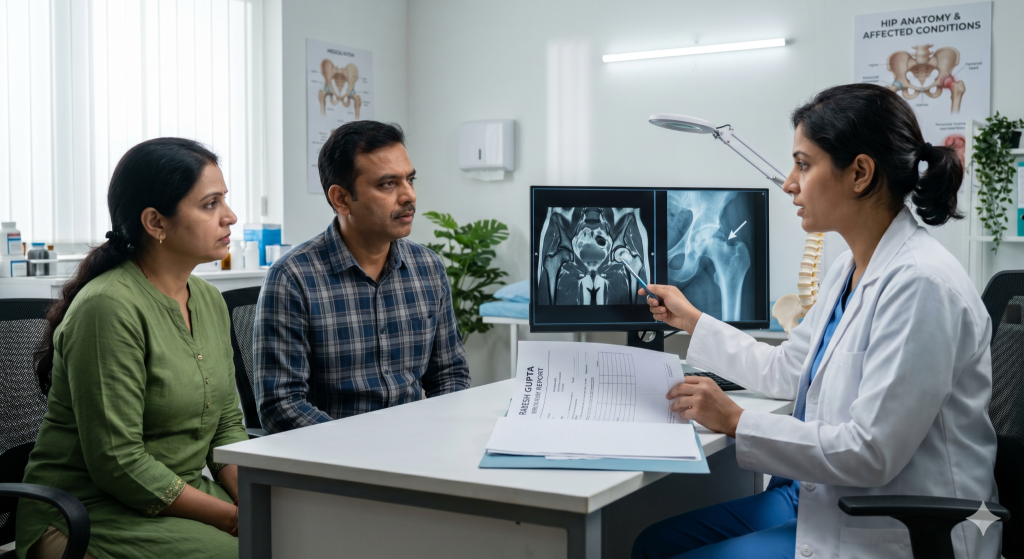
If you visit an orthopaedic doctor in Indore with these symptoms, here is what typically happens:
Physical examination: The doctor checks hip movement, pain on rotation, and walking pattern.
X-ray: Useful in moderate to advanced AVN. In very early stages, X-rays can appear normal.
MRI scan: The gold standard for early AVN detection. An MRI can detect bone changes months before they appear on X-ray. This is why an MRI is recommended whenever AVN is suspected, even if the X-ray looks normal.
When Should You See an Orthopaedic Surgeon in Indore?
Do not wait if you have:
- Hip or groin pain lasting more than 2–3 weeks
- A noticeable limp, even a slight one
- Difficulty walking, climbing stairs, or getting up from a chair
- Hip pain that disturbs your sleep
- Reduced hip movement or stiffness that is getting worse
- History of steroid use, heavy alcohol consumption, or a previous hip injury
These are signs that deserve a proper evaluation, not painkillers and hope.
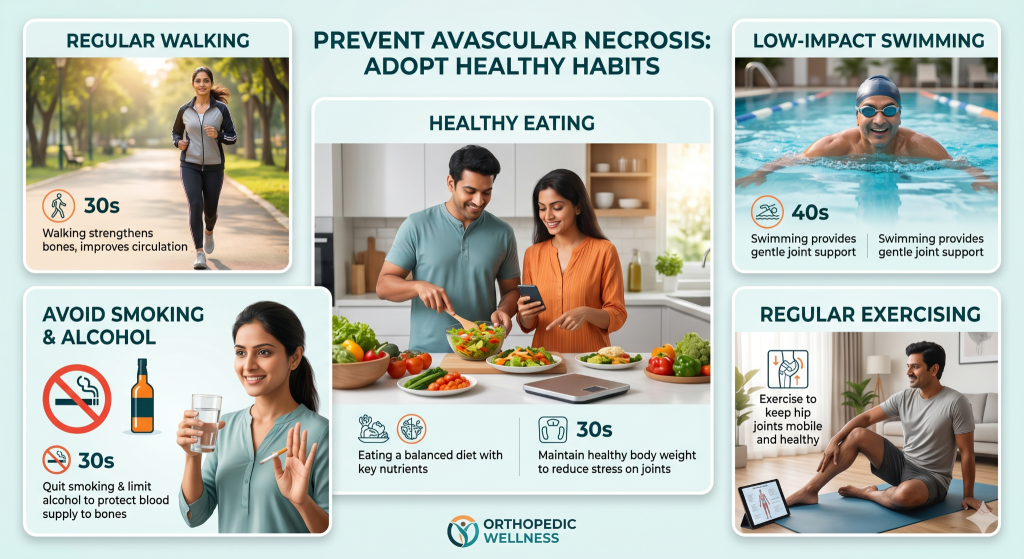
Prevention Tips for Better Hip Health
While not all cases of AVN can be prevented, these habits go a long way:
- Maintain a healthy body weight: Excess weight puts more pressure on hip joints
- Avoid smoking: Smoking reduces blood circulation, including to the bones
- Limit alcohol: Heavy alcohol use is directly linked to AVN
- Exercise regularly : Low-impact activities like walking and swimming keep joints healthy
- Get fractures treated early: A neglected hip injury is a risk factor for AVN
- Avoid unnecessary steroid use: Never take steroids without medical supervision
- Follow up after COVID treatment: If you received steroids during COVID illness, ask your doctor about bone health screening
Avascular necrosis is not a rare condition, and it does not always announce itself loudly. It whispers through groin pain, a slight limp, or difficulty sitting cross-legged. And unfortunately, most people ignore these whispers until the damage is done.
The best time to act is early. With the right diagnosis and treatment plan, many AVN patients live active, pain-free lives without needing major surgery.
Book your consultation with Dr. Tarkit Modi, orthopedic surgeon in Indore, for a personalized AVN evaluation and treatment plan. Early action makes all the difference.
Frequently Asked Questions (FAQs)
Q1. What are the first signs of AVN hip?
The earliest signs of avascular necrosis of the hip include groin pain while walking, mild stiffness after sitting, and slight difficulty in hip rotation. These are often ignored as muscle aches or fatigue.
Q2. Can avascular necrosis heal on its own?
AVN does not heal on its own. Without treatment, the condition almost always progresses and the bone continues to deteriorate. Early medical intervention is essential.
Q3. Is AVN permanent?
If left untreated, AVN causes permanent bone damage. However, if diagnosed in the early stages, the progression can be slowed and — in some cases — further damage can be significantly reduced with the right treatment.
Q4. Can AVN be treated without surgery?
Yes, in early stages, avascular necrosis can be managed with medicines, physiotherapy, lifestyle changes, and activity modification. Surgery becomes necessary only when the disease reaches an advanced stage.
Q5. Which doctor treats AVN in Indore?
An orthopedic surgeon specialising in joint conditions treats avascular necrosis. Dr. Tarkit Modi is an experienced orthopedic surgeon in Indore who diagnoses and treats AVN at all stages.
Q6. What causes sudden AVN after COVID?
Post-COVID AVN is largely linked to the high-dose steroids used during COVID treatment. Steroids reduce blood supply to bones, especially the femoral head, triggering avascular necrosis in susceptible individuals.
Q7. How is AVN diagnosed — is an X-ray enough?
An X-ray may appear normal in early AVN. An MRI scan is the most reliable method to detect avascular necrosis in its early stages, before visible bone damage occurs.
Q8. At what age does AVN usually start?
Avascular necrosis most commonly affects adults between 30 and 50 years of age, though it can occur at any age — especially in those with risk factors like steroid use or alcohol consumption.