

Robotic total knee replacement is a surgical technique where the orthopedic surgeon performs the entire procedure while using a computer-guided system for 3D pre-surgical planning and real-time intraoperative guidance. The technology helps the surgeon personalize the surgical plan to the patient’s knee anatomy, position the implant with greater precision, and better assess alignment and soft-tissue balance during surgery. It does not operate independently the surgeon remains fully in control. Potential benefits include more tailored planning, precise implant positioning, improved alignment assessment, and support for complex knee anatomy, though recovery speed and outcomes still depend on factors like age, muscle strength, arthritis severity, and rehabilitation. Robotic assistance is not automatically better than conventional knee replacement for every patient the right approach depends on individual evaluation by an orthopedic surgeon.
Robotic total knee replacement offers five key benefits: more personalized surgical planning based on the patient’s knee anatomy, greater precision in implant positioning, better assessment of knee alignment and soft-tissue balance, potentially less tissue disruption, and technology support for patients with complex knee anatomy. The orthopedic surgeon performs the surgery throughout; the robotic system only assists with planning and guidance.
For someone dealing with severe knee arthritis, everyday tasks like climbing stairs, sitting on the floor, or walking to the market can become painful and exhausting. When medications, physiotherapy, and lifestyle changes no longer provide relief, doctors may discuss total knee replacement as an option. In recent years, robotic-assisted total knee replacement has drawn growing interest among patients researching their surgical choices.
So what does robotic assistance actually offer? In short: it gives the surgeon additional 3D planning and real-time guidance tools to help position the implant and prepare the bone more precisely, but the orthopedic surgeon performs and controls the entire procedure from start to finish. Below are five potential benefits worth understanding before your consultation.

What Is Robotic Total Knee Replacement Surgery?
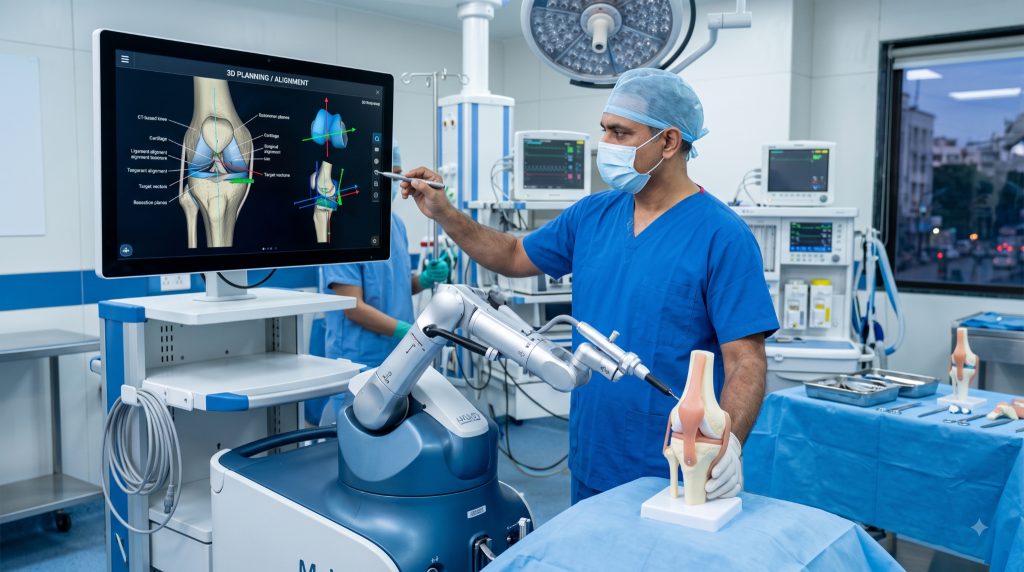
Total knee replacement involves removing damaged cartilage and bone from the knee joint and replacing it with an artificial implant. In robotic-assisted knee replacement, the surgeon uses a computer-guided system that combines pre-surgical imaging with real-time feedback during the operation. According to AAOS’s OrthoInfo resource, this approach combines three-dimensional pre-surgical planning with real-time computer navigation, helping surgeons prepare bone surfaces and position implants with a high degree of accuracy compared to traditional cutting guides.
5 Benefits of Robotic Total Knee Replacement Surgery
1. More Personalized Surgical Planning
Every patient’s knee anatomy is different; bone shape, joint alignment, and ligament tension all vary. Robotic-assisted systems allow the surgeon to build a 3D model of the patient’s knee before surgery, helping tailor the surgical plan to that individual’s anatomy rather than relying solely on standard measurements.

2. Greater Precision in Implant Positioning
Technology-assisted systems can help the surgeon execute planned bone cuts and implant placement with a high degree of accuracy. This does not mean perfect or guaranteed placement in every case; outcomes still depend on the surgeon’s skill, judgment, and the patient’s individual anatomy. What the technology offers is additional real-time feedback during the procedure.
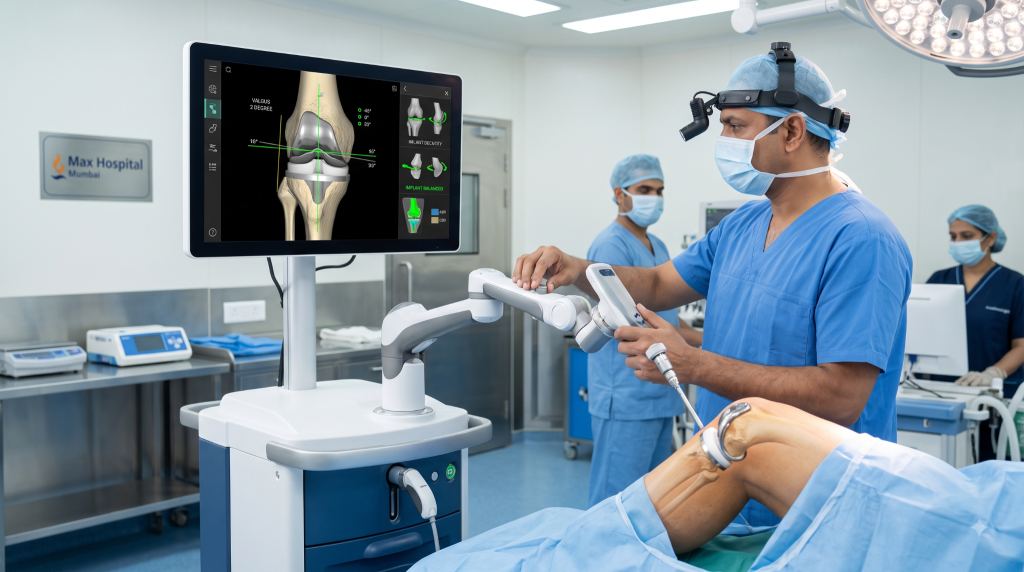
3. Better Understanding of Knee Alignment and Balance
Correct alignment and soft-tissue balance are key factors in how a replaced knee feels and functions afterward. Robotic-assisted platforms can provide the surgeon with real-time data on ligament tension and joint alignment during surgery, supporting more informed intraoperative decisions.

4. Potentially Less Tissue Disruption and Smoother Recovery
Some robotic-assisted techniques are designed to help preserve healthy bone and surrounding tissue during the procedure. However, it would be misleading to promise that every patient experiences less pain or a faster recovery simply because robotic assistance was used. Recovery is influenced by many factors, including:
- Age and overall health
- Muscle strength before surgery
- Severity of arthritis
- Surgical technique
- Post-operative physiotherapy
- Patient adherence to rehabilitation
5. Technology-Assisted Approach for Complex Knee Anatomy
Patients with significant deformities or unusual anatomical variations can sometimes present added surgical challenges. Robotic-assisted planning may help surgeons navigate these cases with more detailed pre-operative information, though the surgeon’s experience and clinical judgment remain central to managing complex anatomy.
Comparison Table: Robotic-Assisted vs. Conventional Knee Replacement
| Feature | Robotic-Assisted Knee Replacement | Conventional Knee Replacement |
| Surgical planning | Technology-assisted 3D planning | Conventional planning methods |
| Surgeon involvement | Surgeon performs and controls surgery | Surgeon performs surgery |
| Implant positioning | Technology assists with planned positioning | Surgeon uses conventional cutting guides |
| Real-time information | May provide additional computer-assisted feedback | Depends on conventional intraoperative assessment |
| Recovery | Varies by patient | Varies by patient |
The best surgical approach depends on the patient’s condition, knee anatomy, the surgeon’s clinical assessment, and the technology available. Neither approach is automatically the right choice for every patient.
Who May Be a Candidate for Robotic Knee Replacement?
Patients who may be evaluated for knee replacement often have:
- Advanced knee osteoarthritis
- Severe, persistent knee pain
- Significant stiffness limiting daily movement
- Difficulty walking, standing, or climbing stairs
- Reduced quality of life due to knee symptoms
- Limited improvement despite appropriate non-surgical treatment
Not every patient with knee arthritis needs a knee replacement, and choosing robotic assistance does not automatically mean surgery is necessary. This decision should always follow a thorough evaluation by an orthopedic surgeon.
Does the Robot Perform the Knee Replacement Surgery?
No. The orthopedic surgeon performs the entire procedure. The robotic system is a technology-assisted tool used for surgical planning and intraoperative guidance it does not operate independently or make decisions on its own. This is a common misconception, and understanding it can help patients approach their consultation with realistic expectations.
What Is Recovery Like After Robotic Knee Replacement?
Recovery after robotic-assisted or conventional knee replacement generally involves early assisted walking within a day or so of surgery, followed by a structured physiotherapy program. Movement and strength typically improve gradually over the following weeks and months, and most patients work toward resuming daily activities in stages. Recovery timelines vary considerably between individuals based on age, health status, muscle strength, and how consistently a patient follows their rehabilitation plan. There are no fixed guarantees on recovery speed or outcome.
Is Robotic Knee Replacement Better Than Traditional Knee Replacement?
Robotic assistance can provide additional planning detail and surgical guidance, but it is not automatically the best option for every patient. The appropriate technique depends on the patient’s knee condition, anatomy, treatment goals, the surgeon’s expertise, and the technology available. Some research, including findings presented at recent AAOS meetings, has associated robotic-assisted total knee arthroplasty with higher patient satisfaction one year after surgery compared to historical benchmarks though individual results still depend on many patient-specific factors, and this shouldn’t be read as a guarantee for any single patient.
If persistent knee pain or severe arthritis is affecting your mobility, consult an experienced orthopedic surgeon in Indore to understand whether knee replacement and whether robotic assistanceis appropriate for your condition. Dr. Tarkit Modi evaluates each patient’s knee condition individually to help determine the most suitable treatment approach.
FAQs
1. What is robotic total knee replacement?
It’s a total knee replacement procedure in which the surgeon uses a computer-guided system for 3D planning and real-time surgical guidance, while personally performing every step of the operation.
2. What are the main benefits of robotic knee replacement?
Potential benefits include more personalized surgical planning, greater precision in implant positioning, better assessment of alignment and soft-tissue balance, and technology support for complex anatomy — though outcomes vary by patient.
3. Is robotic knee replacement better than traditional surgery?
Not automatically. The right approach depends on the patient’s anatomy, arthritis severity, treatment goals, and the surgeon’s clinical judgment.
4. Does a robot perform the knee replacement?
No. The orthopedic surgeon performs the surgery. The robotic system assists with planning and guidance only.
5. How long does recovery take after robotic knee replacement?
Recovery varies by individual and typically involves early walking, physiotherapy, and gradual strength rebuilding over weeks to months, depending on age, health, and rehabilitation adherence.
6. Who is a candidate for robotic knee replacement?
Patients with advanced knee osteoarthritis, significant pain or stiffness, and reduced mobility who haven’t responded adequately to non-surgical treatment may be evaluated as candidates, following an individual orthopedic assessment.
7. Is robotic knee replacement safe?
Robotic-assisted knee replacement is a well-established surgical option performed by trained orthopedic surgeons, with safety depending on standard surgical factors similar to conventional knee replacement.
8. How long does a knee implant last?
According to AAOS-cited data, most knee replacement implants last approximately 15–25 years, though this varies based on patient activity level, weight, and overall joint health.